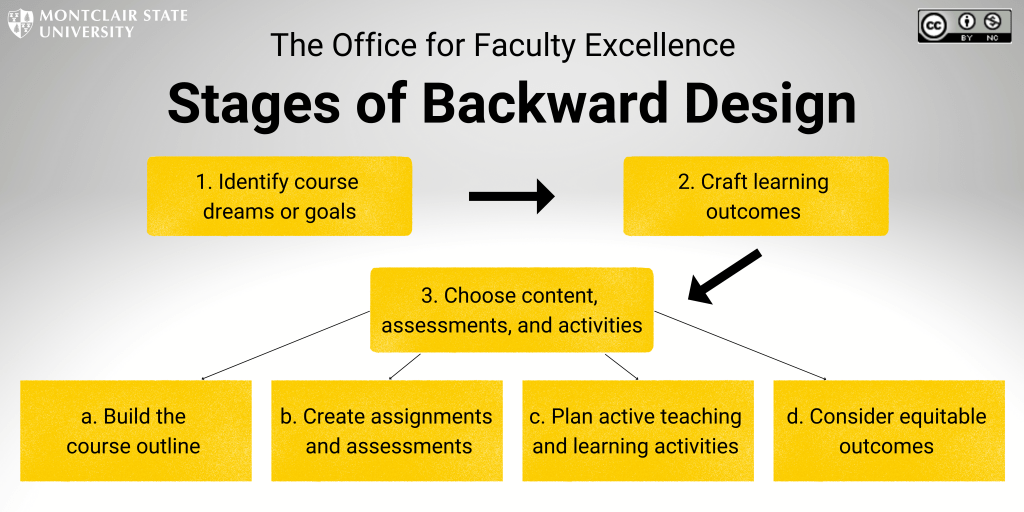
A learning outcome is a statement that specifically identifies the knowledge, skills, or attitudes learners should be able to demonstrate after completing a course or a unit of study. Learning outcomes should be measurable and observable, and clearly stated so that students and instructors understand what is expected and will be measured (Fink 2013; Wiggins & McTighe 2005). Moreover, strong learning outcomes are student-centered, specific, and realistic, appropriate to your discipline and course.
Student-centered learning outcomes describe what students will be able to do, using active verbs. For example, “students will be able to apply concept X to topic Y.” Bloom’s taxonomy offers a useful classification of the types of work students can do to demonstrate learning:
Several free online tools available from the University of Ottawa and the University of Central Florida can help you write good, clear, and student-centered learning outcomes that emphasize the purpose and outcomes of the course. Many instructors find GenAI is helpful for turning your goals for the course into clearer and more concise outcomes. Fink (2013) identifies six key areas to consider when developing learning outcomes: foundational knowledge, application, integration, human dimension, caring, and learning how to learn.
Here are some sample learning outcomes from various disciplines: Students will explain and evaluate how researchers apply the principles and standards from the APA Ethics Code in the design, data collection, interpretation, and reporting of psychological research. (Psychology)
- Students will create documents that demonstrate an understanding of common technical writing genres. (Technical writing)
- Students will describe and predict basic thermodynamic state functions (∆H, ∆G, ∆S) for chemical reactions. (Chemistry)
- Students will explain the major processes operating in earth science including plate tectonics, waste disposal, the origin of mineral and energy resources. (Earth Sciences)
- Students will develop a defensible holistic novel business approach with the understanding of why this is critical to success in a highly dynamic context. (Entrepreneurship)
See additional learning objective examples.