
Course Design Models
Course design frameworks establish consistency in design while providing a model to follow throughout development and while teaching, enabling the integration of pedagogical best practices throughout each element of your course. In short, course design frameworks make your course the best it can be, enhance the student experience, and streamline the teaching experience for faculty.

Backwards Design: Designing With Goals in Mind
A student’s learning journey in your course concludes with their achievement of goals defined by you at the start of the semester. What concepts should be mastered, and how do we facilitate that mastery? The path to achieving those goals typically entails students’ active engagement with course materials, activities, discussions, assessments and much more.
The backwards course design model helps you facilitate your students’ learning journey by planning every aspect of your course around your course goals. The lectures you plan, the activities and assessments you design, and the way you organize your content should be inspired by (and align with) these learning goals to help students achieve them.
Wiggins and McTighe’s Understanding by Design (UbD) framework follows a “backwards” design approach. They recommend you start by defining your course goals and learning outcomes (LOs). You then determine learning assessments. What evidence is needed to confirm students met LOs? Lastly, you design learning activities. How can students develop LOs? Consider ways to structure, chunk, and present content. Regardless of the modality you teach in, all activities, content and assessments should connect back to what you want your students to know or do as a result of your course.
The diagram below illustrates an example of the alignment between course goals, learning objectives and learning outcomes for a course. Take a look at more details about this course and the assignments: The Sociology of Cyberspace
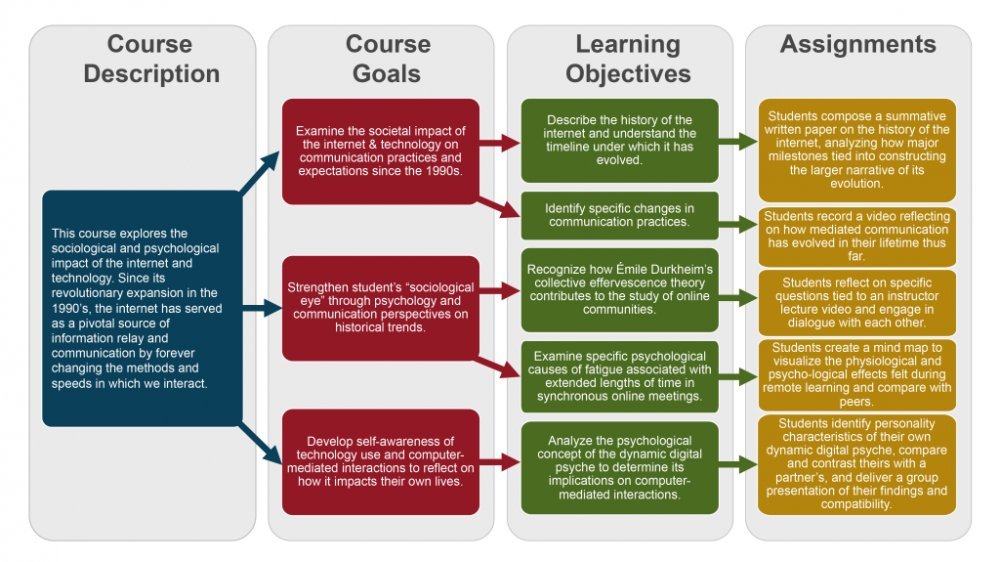
Diagram Description: The diagram is divided into four vertical sections, each titled with a heading. The sections are organized from left to right: "Course Description," "Course Goals," "Learning Objectives," and "Assignments." Each section is a rounded rectangle in a different color, with arrows indicating the flow from one section to the next.
- "Course Description" is in a dark blue rectangle. It details the focus of the course on the sociological and psychological impacts of the internet and technology, highlighting the rapid evolution since the 1990s.
- "Course Goals" is in a red rectangle. It describes the aims of the course, such as examining the societal impact of the internet, reinforcing sociological perspectives, and developing self-awareness in technology use.
- "Learning Objectives" is in a green rectangle. It lists objectives like understanding the internet's history, identifying communication changes, and analyzing psychological impacts.
- "Assignments" is in a brown rectangle. It outlines tasks for students, such as writing a paper on the internet's history, recording reflection videos, and creating mind maps.
Montclair’s OCIA Course Design Model
Once the course goals have been defined and mapped to assignments and activities, the OCIA Course Design model can help. The Instructional Technology and Design Services team has developed a course design model in collaboration with faculty members for use at Montclair State University called OCIA (Orientation-Content-Interaction-Assessment) guided by the nationally recognized Quality Matters rubrics, and Rubric for Online Instruction from California State Chico.
Our model supports a social, interaction-embedded approach to course design and development and uses learning modules to structure the course. Each learning module, based on OCIA, contains all the essential elements for learning activities that students can complete within a period of time (generally one week). This structure guides learners through a predictable sequence but is flexible in that it can be customized to fit a range of methods for facilitating and assessing learning.
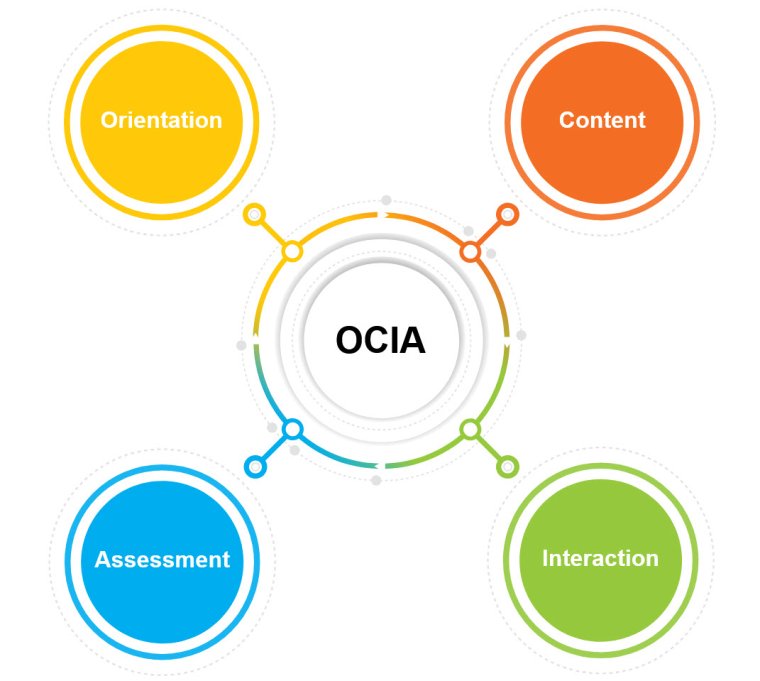
Our OCIA model includes four main components:
Course Design Consultations

Need Assistance?
Our team of instructional designers are available to collaborate with you on many aspects of designing your course(s). We are committed to learning from recent trends in learning science while leveraging the latest instructional technologies to support student learning and engagement. Some aspects of the course design process can take time to develop so it is best to start the process a semester before the course is going to be offered. The better designed the course is in advance, the more time you will be able to devote to facilitating the course.