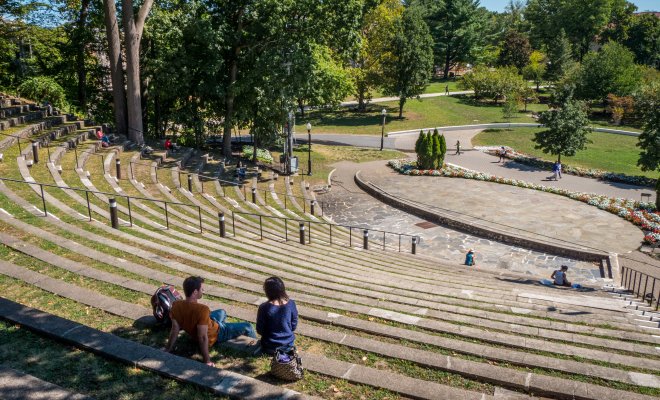
People sitting on tiered outdoor amphitheater seating on a campus

Both Classics and Humanities will develop your ability to conduct critical inquiry into past cultures and modern manifestations of their ideas and values. It is the original interdisciplinary subject, encompassing the fields of literature, myth studies, history, philosophy, religious studies, archaeology, the visual arts, and more. A multitude of interesting and challenging classes will sharpen your critical-thinking skills and prepare you to pursue virtually any career after graduation.
Make a Gift

The Classics and Humanities Department is committed to supporting students and providing quality lectures and presentations for both the campus and community. Your gift to the Classics and Humanities Department will help support scholarships or events sponsored by the department.

To give online, please type in “Classics and Humanities Department” in the “Gift Designation” field below.

Programs of Study

The department offers a range of undergraduate programs that explore the ancient world, classical languages, humanities and interdisciplinary studies. Whether your interests lie in history, literature, mythology, archaeology, language or culture, our programs provide opportunities to engage with the ideas, traditions and societies that continue to shape the modern world.

Majors and Minors

Combined Programs


The Classics Major and Classics Minor are broad programs in ancient civilization which study the history, languages, literature, philosophy art, religion, and daily life of the ancient Mediterranean world as seen through texts and artifacts. The major and minor in Latin emphasize the study of literature in the original language and requires study of introductory Greek as well. The Latin Major with Teacher Certification in Latin leads to certification to teach Latin and Classics in the schools. The Minor in Greek emphasizes mastery of classical Greek and reading literature in the language.

The Ancient Mediterranean Civilizations Minor examines the fascinating history, cultures, institutions and societies of the ancient Mediterranean region, broadly understood to include cultures such as those of the Near East and Egypt as well as Greece and Rome.

The department is a sponsor, together with the departments of Anthropology, Art and Design (Art History faculty), and Earth & Environmental Studies, of the Archaeology Minor and of an archaeological research project conducted by Montclair State’s Center for Heritage and Archaeological Studies at the “Villa of the Antonines” near Rome.

The Humanities Major critically examines the culture, ideas, and values of earlier cultures, both in their original time periods and as they have been appropriated and transformed by later ages. This program combines courses in our department with a breadth of courses offered in other departments (history, literature, philosophy, religious studies, art history, music history) thus providing students with a truly interdisciplinary and flexible major. The Humanities major offers the opportunity to complete a K-6 Teacher certification

The Myth Studies Minor examines the foundations of human thought and culture as expressed in myth and mythology, and the related genres of folklore, legend, oral tradition, and ritual. Using resources from fields like literary studies, classics, religious studies, philosophy, drama, art, and psychology, the Myth Studies Minor allows students to explore the creation and use of narrative and symbol in ancient cultures, such as the Greek, Roman, Celtic, Norse, and Egyptian, and in modern contexts, such as popular culture.

The Bachelor of Arts in Liberal Studies is a fully online degree completion program designed for students who have completed 60 or more college credits and are ready to finish their bachelor’s degree. Whether you’re a transfer student, returning to college after a break, a non-traditional student or resuming your studies as a readmitted Montclair student, this program provides a flexible path to graduation.


Awards and Scholarships

To apply, contact Dr. Patricia Salzman 

or Dr. Prudence Jones

Applications are due in April.

The Kibbe Scholarship, in the amount of $300, will be awarded in the Spring to a student having declared an academic major in Latin or Classics. The recipient must be a Montclair State student returning in the Fall and have earned a cumulative GPA of 3.0.

The Peins Scholarship, in the amount of $1000, will be awarded this Spring to a student pursuing an academic major in Classics and a minor in Latin. The recipient must be a full-time junior or senior and have earned a cumulative GPA of 3.2 and a GPA of 3.5 in at least two Latin courses. This award is intended for students who do not qualify for any other financial aid.

The McVean Scholarships in the amount of $2500 will be awarded this Spring to two students pursuing an academic major in Latin or Classics. Priority will be given to students who will be juniors and seniors at Montclair State and will take into account academic merit and financial need.

The Christos Hatzoglou Memorial Scholarship in the amount of $1200 will be awarded this Spring to a student pursuing an academic major in Classics or Latin. The recipient must be a Montclair State student in the following academic year.

Career Opportunities for Majors and Minors

  • Independent learning skills – Learning how to learn.
  • Research skills – Knowing where to find information and ideas, and being able to critically judge between various sources of ideas.
  • Writing skills – The ability to structure your thoughts coherently and express yourself in ways that are appropriate to the occasion.
  • Speaking skills – The ability to confidently and clearly express your ideas. The ability to convince someone of your arguments and persuade them of your point of view.
  • Critical thinking skills – The ability to tell better ideas from worse, the ability to test ideas by subjecting them to relevant criteria.
  • Problem-solving skills – The ability to understand and express a problem that needs to be solved, and the knowledge of various methods of analysis that might be relevant to the problem.
  • Interdisciplinary skills – The ability to work at the borders of traditional forms of knowledge, using the resources from more than one area to help define a problem and suggest approaches to it.
  • Global understanding and cultural sensitivity – The ability to appreciate cultures and religious traditions outside of your own.
  • Historical understanding – The ability to see how and why things came to be as they are.
  • Aesthetic understanding – The ability to recognize and produce visual, narrative, and musical structure, order, and appeal.
  • Perspectival understanding – The ability to understand how other people or groups think.
  • Adaptability – The ability to apply knowledge and skills to a wide variety of contexts.
  • The ability to ask good questions – Recognizing that all knowledge is really the answer to questions, and that truly understanding something means understanding the questions that are asked, and being able to refine those questions to produce better knowledge.
  • Time and resource management skills – The ability to work under pressure and maximize resources to produce a desired outcome.
  • Linguistic skills – The ability to operate in more than one language.
  • Advertising. Your study of human culture and society can prove very helpful when trying to figure out how people might react to a certain kind of ad–and your specific background, be it music, philosophy or beyond, can enable highly creative thinking.
  • Business. With its emphasis on writing, problem-solving and human management skills Business is an area in which humanities majors are uniquely suited. Jobs include: administrative assistant, administrator, newsletter editor, personnel director, program coordinator, Researcher, Sales Director, Public Relations, Labor Relations, Arbitrator
  • Fine Arts. Humanities study is a traditional preparation for careers in the Fine Arts. These jobs include: Teaching, Arts Administration, Museum (Director, Curator of collections, Director of operations, Community arts programs including philanthropy or fund-raising; consultant, coordinator or buyer for commercial art; conservation, historic preservation; collecting, evaluating, appraising, art therapy, music therapy.
  • Foreign Service. Especially if you’ve majored in the study of a particular culture, your ability to understand the workings of human society are invaluable when trying to work in a foreign country.
  • Government. You are well prepared for service to your country with a humanities major. Jobs include: administrative assistant, administrator, media consultant, program director, analyst, researcher, FBI, CIA, Civil Rights Commission, consumer affairs, cultural affairs, Department of Education: Youth and Family Services, national.
  • Journalism. Good communicative skills and the ability to think analytically are the most important qualities for a journalist. Many top journalists have humanities and liberal arts backgrounds instead of journalism school degrees.
  • Law. Humanities majors are the most common prerequisites for law school. It may seem to require a lot of rote memorization of court cases and laws, but by far the most crucial attribute for any lawyer is the ability to think critically and to relate current issues to past ones (history is a popular undergraduate degree for law students).
  • Medicine. Medicine (if you have the necessary “premed” courses) and healthcare are careers that benefit from a humanities background. Aside from these, there is work in healthcare facilities: administration, management, program directors, government-funded agencies, health advertising agencies, pharmaceutical companies, residential treatment facilities.
  • Public administration. If you’ve studied how societies work, you’re probably qualified to help make them work.
  • Publishing. This is a good choice for literature and communications majors, who must be able to recognize quality writing when they see it and champion it to publishers and the reading public.

Our Faculty

1/

Contact Us

Classics and Humanities News