
Human Flourishing
Human Flourishing in Teaching and Learning
Human flourishing is an interdisciplinary approach to well-being and human development that considers how people learn, grow, relate, find meaning, and contribute across their lives. Montclair's Human Flourishing work draws from interdisciplinary scholarship and evidence-informed practices, including research and resources from the Center for Healthy Minds at the University of Wisconsin–Madison.

Flourishing is an ongoing process of cultivating human capacities through moment-to-moment experience that help us learn, adapt, connect, grow, and find meaning across different stages of life. In education, Human Flourishing invites us to consider the whole person. Learning is not only cognitive: attention, emotions, relationships, identity, values, embodied experience, purpose, and the environments in which learning occurs all shape how students learn and develop. Recognizing the body–mind connection, a Human Flourishing approach creates opportunities for intellectual learning to be accompanied by reflection, relational development, and meaningful engagement.
Human Flourishing is also interconnected: we do not flourish alone. We develop through relationships, communities, and the environments and systems of which we are a part. Flourishing therefore involves developing greater awareness of ourselves and cultivating our inner capacities while strengthening how we relate to others and contribute to the world around us.
From this perspective, education can help create an ecosystem for flourishing in which curricular and co-curricular experiences, relationships, and the broader life of the university support whole-person development. This approach recognizes our shared responsibility to provide every student with opportunities to cultivate capacities for learning, growth, connection, resilience, and meaningful participation in the world.
Through evidence-informed practices and repeated experience, students can strengthen their capacity to be present and attentive, understand their emotions, explore identity and values, build meaningful relationships, navigate challenge and change, and engage with their lives and communities with greater curiosity, compassion, purpose, and intention.
Foundations for Flourishing
Before cultivating specific Human Flourishing capacities, it is helpful to understand how learning, adaptation, and growth develop over time. Three foundations help explain how change becomes possible:
- Growth Mindset — approaching challenge, feedback, effort, and mistakes as opportunities for learning and development.
- Positive Neuroplasticity — recognizing the brain's biological capacity to change and adapt in response to experience. Through repeated experiences and intentional practice, patterns of attention, learning, and response can be strengthened over time.
- Resilience — developing the capacity to adapt, recover, and re-engage while navigating difficulty, uncertainty, setbacks, and change.
Flourishing develops within conditions that support growth, not through individual effort alone. Relationships, environments, experiences, and emotional and physiological states also influence learning and development.
Putting the Capacities Together: The P.R.E.S.E.N.T. Model
Human Flourishing capacities often work together in everyday moments of learning, challenge, uncertainty, and change.
The P.R.E.S.E.N.T. model, developed by Dr. Elenice De Souza Oliveira through her Human Flourishing work as a HEAL Fellow at Montclair, offers an integrative practice for moving from awareness toward reflection, agency, adaptability, and meaningful action:
P — Pause: Create space between reaction and response.
R — Resource: Recognize internal and external sources of support, stability, strengths, and possibility.
E — Expand: Broaden perspective and consider possibilities for learning and growth.
S — Step In: Identify one small, meaningful, and realistic action.
E — Envision: Imagine yourself engaging in that action with intention.
N — Neuro-integrate: Pause to notice and absorb what feels meaningful, encouraging, or supportive in the experience.
T — Translate: Carry insight into continued action, reflection, and practice.
Rather than a rigid sequence, P.R.E.S.E.N.T. can be understood as an iterative process of noticing, reflecting, adapting, acting, and integrating learning over time.
Start Small
Supporting Human Flourishing does not require redesigning an entire course. An ecosystem for flourishing grows through the everyday ways we teach, listen, communicate, invite participation, respond to challenge, and create opportunities for reflection and connection.
Faculty can begin with one intentional pause, one opportunity for focused attention, one reflective question, one meaningful conversation, one moment of perspective-taking, or one invitation to connect learning with identity, values, purpose, or contribution.
Small practices, repeated over time and across classrooms, mentoring, advising, and other university experiences, can contribute to a culture in which students have meaningful opportunities to develop their capacities, grow through challenge, connect with others, and engage more intentionally with their learning and communities.
Explore Human Flourishing More Deeply
The Human Flourishing Community of Practice in Canvas provides a deeper learning pathway for faculty, staff, advisors, mentors, and educators interested in exploring and applying Human Flourishing in teaching, mentoring, advising, leadership, collaboration, and everyday life. Resources include the Foundations for Flourishing, the five Human Flourishing capacities, the Human Flourishing Toolkit, guided experiential and reflective practices, the P.R.E.S.E.N.T. model, and applications across educational and relational contexts.
The Community is designed to be flexible. Participants may follow the modules as a structured learning pathway or select practices most relevant to their current needs and contexts.
Building a Culture of Human Flourishing at Montclair
Human Flourishing at Montclair has grown through an interdisciplinary and collaborative process involving faculty, staff, students, peer mentors, academic coaches, campus leaders, and external scholars and practitioners.
Beginning with the Fall 2024 Human Flourishing Workshop Series, the work has expanded from faculty and staff development into student programming, mentoring and coaching, curricular development, cross-campus dialogue, and opportunities to connect the Montclair community with national and international scholarship on flourishing.
Highlights include:
- Fall 2024 Human Flourishing Workshop Series — Five workshops exploring resilience, awareness and mindfulness, connection and interdependence, identity and values, and purpose. Guest contributors included Teri Pipe, Ph.D., RN, Core Faculty at the Center for Healthy Minds and Professor of Practice in the School of Nursing at the University of Wisconsin–Madison, as well as Montclair colleagues contributing perspectives on belonging and student flourishing.
- Human Flourishing in Graduate Education — Fall 2024 — A special workshop at Montclair's Graduate Summit engaging graduate program coordinators, department chairs, doctoral program directors, staff, and Graduate Council members in considering Human Flourishing within graduate education.
- Human Flourishing Student Ambassador Panel — Spring 2025 — A dialogue with representatives from the University of Wisconsin–Madison's Human Flourishing Student Ambassador initiative, including Dr. Susan Huber, Nick Shaskhko, and Lamont Johnson Jr., together with Montclair campus leaders, exploring possibilities for student-led flourishing initiatives.
- Pre-Medical Student Engagement — Spring/Fall 2025 — Human Flourishing programming expanded to Pre-Medical students and peer mentors, including work on positive neuroplasticity, resilience, well-being, mentoring, and the development of capacities relevant to future health professionals.
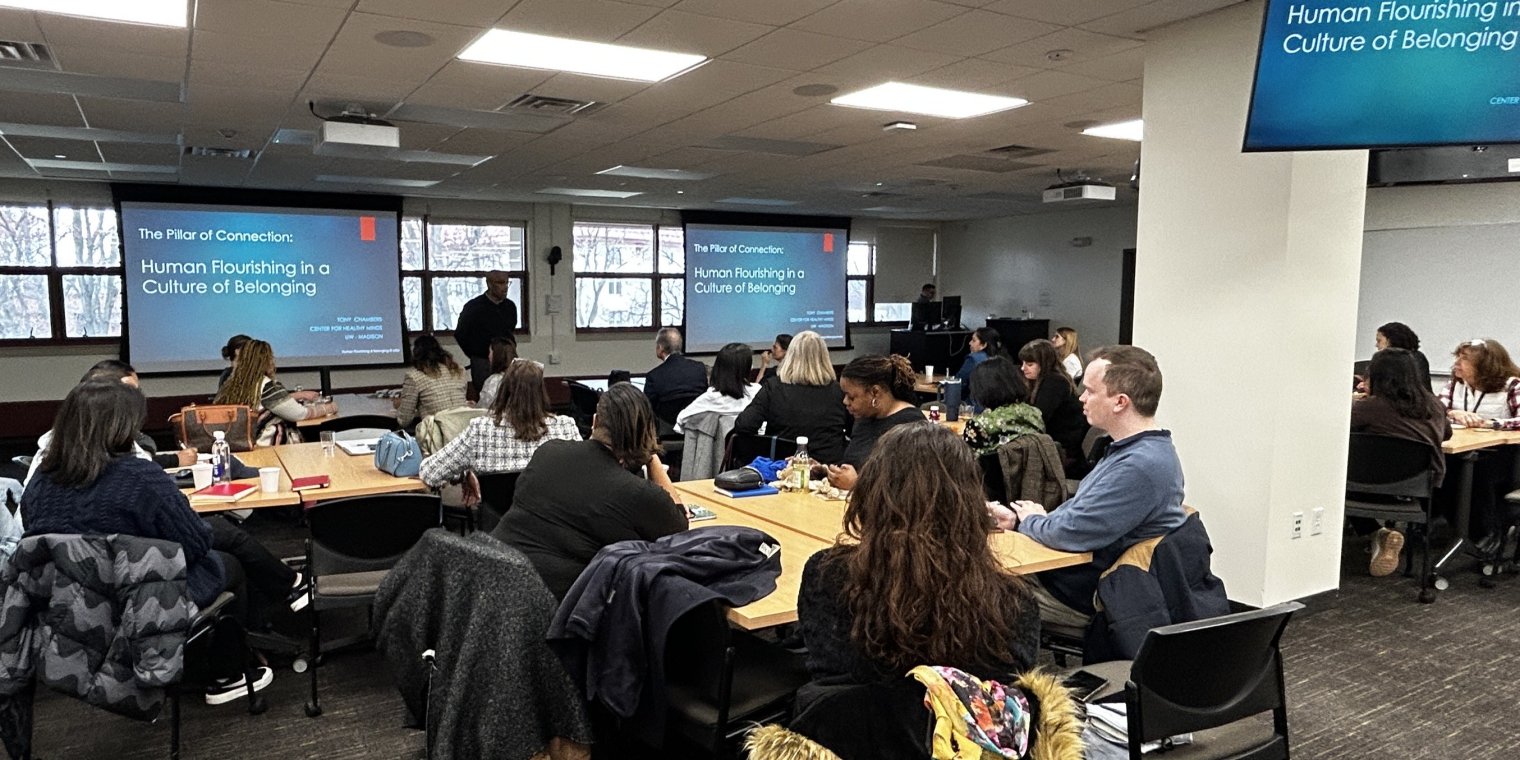
- The Pillar of Connection: Human Flourishing in a Culture of Belonging — Spring 2025 — Dr. Tony Chambers, Director for Community Well-Being at the Center for Healthy Minds at the University of Wisconsin–Madison, joined the Montclair community for an interactive workshop exploring connection, belonging, and community well-being.
- Human Flourishing Course Development — 2025–2026 — Interdisciplinary collaboration supported the development of Human Flourishing curriculum focused on whole-person learning, self-discovery, resilience, emotional awareness, interdependence, purpose, and civic life.
- Working Group on Education for Human Flourishing — Spring 2026 — Flourishing in Education: Self, Others, and Together brought faculty and staff together to explore Human Flourishing through mindset, resilience and neuroplasticity; awareness and attention; emotional and relational flourishing; purpose and meaning; global flourishing; and ecological flourishing and educational systems. The series opened with Amrita Chaturvedi, Ph.D., Chair of the Consortium for Human Flourishing at Saint Louis University.
- Global Flourishing Study and Flourishing Education in Practice — Spring 2026 — Matthew T. Lee, Ph.D., Professor of the Social Sciences and Humanities at Baylor University, Director of the Flourishing Network, and Research Associate with the Human Flourishing Program at Harvard University, joined the Montclair community for Wisdom about the Good Life from the Global Flourishing Study and a roundtable on translating flourishing research into educational practice.
- Signature Dialogue: Creating a Flourishing Life — Spring 2026 — A student-centered dialogue with Dr. Matthew T. Lee invited students to explore flourishing, meaning, purpose, and questions about living a good life.
- Human Flourishing for CAST Academic Coaches and Tutors — Spring 2026 — A workshop series brought Human Flourishing capacities and practices into academic coaching, tutoring, mentoring, communication, and student support.
All these initiatives reflect an evolving commitment to Human Flourishing across curricular and co-curricular life from classrooms and faculty development to mentoring, advising, coaching, student dialogue, and community engagement.
Additional Resources
Center for Healthy Minds — University of Wisconsin–Madison
Interdisciplinary research on the science of well-being and flourishing, drawing from fields including neuroscience, psychology, education, contemplative science, and the humanities. The Center studies how well-being can be cultivated in individuals and communities.
The Art and Science of Human Flourishing / Student Flourishing Initiative — University of Wisconsin–Madison
An interdisciplinary and experiential approach to Human Flourishing that integrates scientific inquiry with practices related to Awareness, Connection, Insight, and Purpose. The Center for Healthy Minds describes the Art and Science of Human Flourishing as a semester-long UW–Madison course and the foundation for its broader Student Flourishing Initiative.
Healthy Minds Program App
A freely available well-being app developed by Healthy Minds Innovations. It combines lessons and guided practices informed by neuroscience and contemplative traditions and is organized around Awareness, Connection, Insight, and Purpose.
Human Flourishing Program at Harvard University
Interdisciplinary research on human flourishing and the conditions that help individuals and communities thrive.
Global Flourishing Study at Harvard University
The Global Flourishing Study follows more than 200,000 participants across 22 countries and examines dimensions including happiness and life satisfaction, physical and mental health, meaning and purpose, character and virtue, close social relationships, and financial and material stability.
Student Flourishing at Emory University
Integrates Emory's curriculum with campus experiences and opportunities to embrace the "whole student."