
Teaching with AI: Tips and Ideas
AI-rich environments are reshaping how faculty think about course design, learning goals, assessment, academic integrity, and ethics. They also bring renewed urgency to perennial pedagogical questions, including how to foster meaningful student engagement and connect disciplinary learning to professional practice and real-world contexts. As AI becomes more integrated into academic and professional work, faculty also play an important role in practicing responsible data use and helping students develop the data privacy and security habits needed to use AI safely.
Jump to topic:
Best Practices for Safe AI Use
- As you might already know, not all data faculty can access and handle at work is public, and the distinctions are sometimes tricky. If you are unsure whether specific data can be entered into AI systems, please refer to Data Classification and Handling policy.
- When possible, use institutionally licensed tools for work tasks. As of August 2026, Google Gemini and MS Copilot are licensed to be used with data protection for users with Montclair login credentials.
AI and Learning Outcomes
As faculty adapt their teaching to AI-rich learning environments, the principles of effective course design remain unchanged. As you work on identifying the areas of your teaching practice that can be re-envisioned or adjusted for increased student success, it can be helpful to start with the learning outcomes. The impacts of AI on different disciplines, as well as on different courses within the same discipline, can vary greatly, so it is essential to reexamine the learning objectives critically, with these questions and considerations in mind:
- what constitutes must-know foundational knowledge and skills for this course and this discipline;
- what tasks are typically supported by or outsourced to AI tools in professional practice;
- what tasks have a high learning value for the students enrolled in this course, even if these tasks may be automated or AI-supported in professional practice.
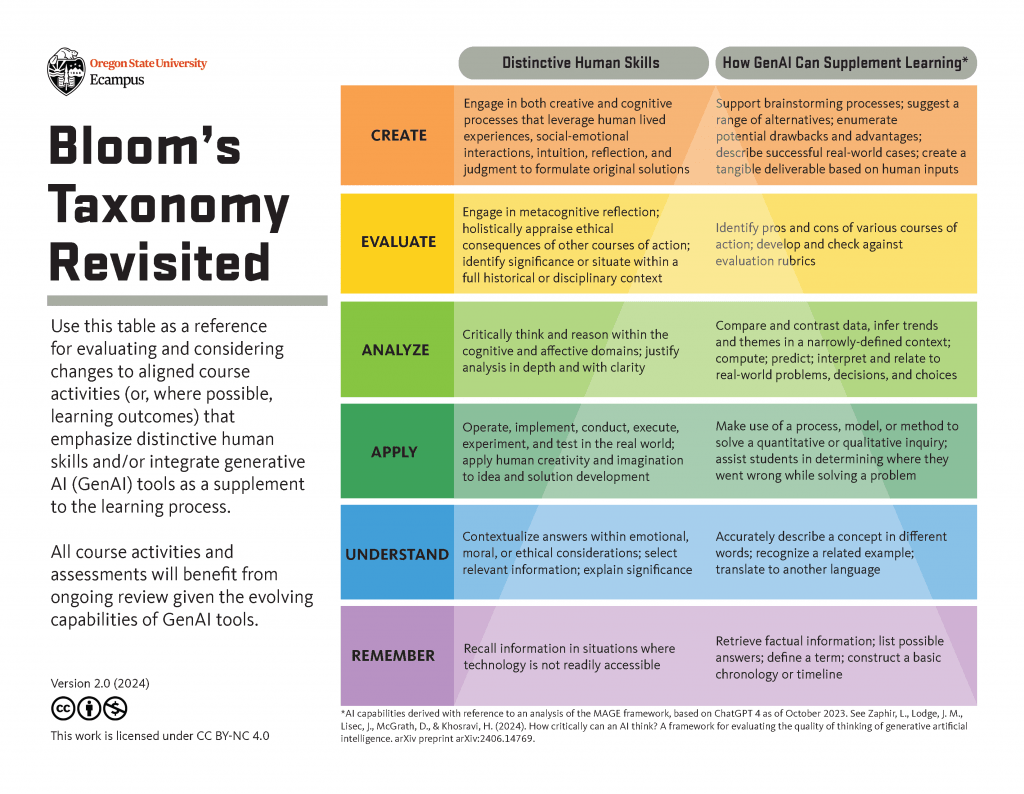
Frameworks such as Oregon State University’s “Bloom’s Taxonomy Revisited” can help guide faculty in considering how student learning outcomes are changing in the age of AI.
AI for Teaching and Learning: Disclose and Explain
Disclose and explain how you use AI to support your teaching. Setting an example of disclosing and explaining impactful AI use would be extremely educational for students, modeling professional behavior and ethics around AI use for them.
- Remember that automatic AI detectors are also AI systems. While their suggestions are not always reliable and often would not be accepted as strong evidence of inappropriate use of AI, it is understandable that many faculty still turn to them.
- If you choose to use a digital platform to support detection of AI use, make sure that your process remains FERPA-compliant and no personally identifiable information for any students is entered into third-party tools without institutional license.
- We recommend that you explain this part of your assessment process to your students prior to entering student submissions into any AI-detecting systems.