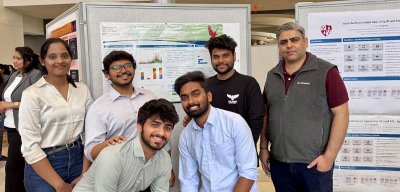
students and mentor with poster at capstone student showcase

School of Computing

The School of Computing strives to deliver high-quality computing education and research that fosters innovation, critical thinking, and real-world problem-solving. By integrating emerging technologies, advancing interdisciplinary research, and collaborating with industries, it prepares our graduates to thrive in a rapidly evolving digital landscape and become leaders in future technological innovation.

Aiming to be a global leader in computing education and research we offer a transformative student experience that prioritizes active learning and real-world problem-solving. Through hands-on labs and programs using industry-level hardware and software as well as interdisciplinary skill development, the SoC empowers all students to excel in the workforce, drive technological innovation, and contribute to an AI-driven world that prioritizes humanity and societal well-being. At the research level, the SoC fosters innovation by forming interdisciplinary clusters that unite and augment faculty expertise and capacities across health, engineering, security, and computing. These clusters promote impactful collaboration, addressing complex challenges and delivering solutions with significant real-world implications.


Our Values

Research Clusters

The School of Computing has six research clusters creating a foundation for interdisciplinary research that brings together expertise in computing, health, and engineering. The research clusters offer students access to a wealth of expertise and state-of-the-art resources, fostering a vibrant, interdisciplinary environment.

ANCS aims to establish a strong foundation for scalable computing systems, network architectures, and the study of complex adaptive systems. As computing continues to evolve, challenges related to efficiency, scalability, and interconnected systems are becoming increasingly significant.

Faculty Involved

Artificial intelligence (AI) is rapidly reshaping the landscape of modern computing, offering new opportunities for intelligent automation, decision-making, and system adaptability. The AIES research cluster at Montclair State University focuses on harnessing AI to develop innovative, high-performance systems that are capable of autonomously improving and responding to dynamic challenges. By integrating AI into the core architecture of computing systems, we aim to create self-optimizing, data-driven frameworks that can learn, adapt, and scale as needed to address complex, real-world problems.

Faculty Involved

The Neuro-Physiological Computational Learning (NPCL) Cluster is an interdisciplinary research initiative situated at the intersection of neuroscience, physiology, artificial intelligence, computational modeling, and reinforcement learning. By integrating these fields, the cluster aims to deepen our understanding of cognitive processes and improve intelligent systems, particularly for learners with special needs in STEM education, crisis decision-making, and real-world applications such as defense, military operations, cybersecurity, and human errors in computing.

Faculty Involved

Data science has emerged as a transformative force in today’s research landscape, impacting nearly every field from healthcare to cybersecurity. The IDES cluster seeks to push the boundaries of data engineering and applied data science by fostering collaboration across disciplines and enabling the creation of data-driven solutions for complex, real-world problems. The research agenda can be organized around three key pillars: theoretical foundations, methodological advancements, and industry standards.

Faculty Involved

As software systems become more complex, ubiquitous, and interconnected across various domains—including finance, healthcare, transportation, and critical infrastructure—the need for reliability and privacy has never been more urgent. The Software Engineering, Reliability, and Privacy (SWRP) Cluster is dedicated to advancing research in secure and resilient software engineering practices. This cluster brings together interdisciplinary expertise to address fundamental challenges in building dependable, privacy-conscious, and secure software systems capable of withstanding evolving cybersecurity threats and operational disruptions.

Faculty Involved

The CPRS cluster focuses on building secure and resilient systems for the next generation of interconnected technologies. Cyber-physical systems (CPS) combine physical components (like sensors, actuators, and machinery) with digital elements (such as software, networks, and AI) to create interconnected systems that operate in critical sectors like energy, healthcare, transportation, and defense. However, the interconnected nature of CPS introduces vulnerabilities that must be addressed through resilient design, cybersecurity, and real-time response mechanisms. This cluster’s research aims to solve problems specific to IoT, smart infrastructure, autonomous systems, and other critical infrastructures, ensuring that these systems can continue to function even under extreme conditions.

Faculty Involved