
Student Information
Learn about transferring credits
The First-Year Writing Program provides undergraduate students with coursework required to fulfill the University General Education Communication requirements in Writing and consists of two courses: College Writing I (WRIT 105) and College Writing II (WRIT 106). Both courses are offered in traditional, online, and hybrid course formats.
The Purpose of First-Year Writing Courses
First-Year Writing courses, which collectively fulfill the general education requirements in Reading and Writing, ask students to write argumentative essays based on intellectual prose and contemporary issues. Our full sequence of courses (WRIT 105 and 106) are concerned with the kind of intellectual inquiry that drives learning in school, work, and everyday life. The writing students do in the First-Year Writing Program is meant to sustain and continue their development as writers for the length of their college careers and beyond.
College Writing I (WRIT 105)
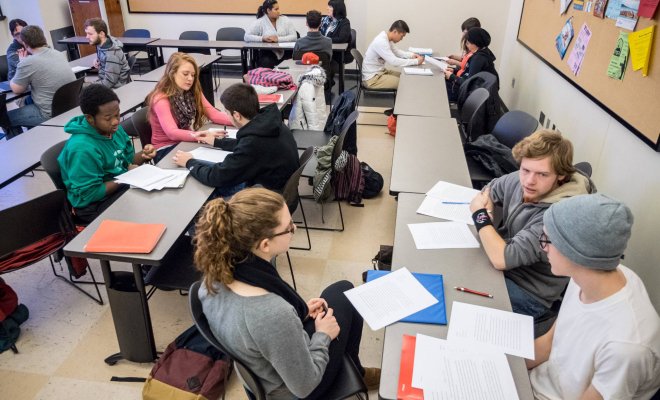
This course is a writing-intensive workshop designed to develop thinking and writing abilities through frequent writing assignments based on critical response to intellectually challenging questions. We emphasize the writing process: prewriting, drafting, revising, using peer and teacher critique, editing and proofreading. Each assignment undergoes a series of drafts and revisions, and at least one of which includes external research beyond assigned course readings. In lieu of a final exam, students complete a portfolio of revised writing. The central goal of WRIT 105, College Writing I is not just to help students to become effective writers of intellectual arguments, but to also provide them with the critical thinking and research skills that are instrumental to a successful university education. Combined with WRIT 106, College Writing I meets the Gen Ed 2002 Communication Requirement in Writing/Literature. It also meets the 1983 General Education Requirement (GER)-Communication in Writing. Class size: 19.
College Writing II (WRIT 106)
College Writing II builds on the writing strategies taught in College Writing I and extends the goal of helping students to become effective writers of intellectual arguments in response to genre- and discipline-based works from a variety of fields. Students continue to practice and develop as writers, but the focus in this course is on reading and interpreting a diversity of texts across multiple modes. Each assignment undergoes a series of drafts and revisions, including at least one documented essay that engages students in their own process of academic research, is required. The central goal of WRIT 106, College Writing II, is to help students expand upon their critical thinking and writing skills and build an appreciation of a diversity of intellectual texts. Class size: 19.
First-year Writing Faculty
The First-Year Writing (College Writing I and II) faculty are a diverse group of writers, educators and artists who are committed to the First-Year Writing students at Montclair State University. Faculty come to the teaching of WRIT 105 and WRIT 106 with joint enthusiasm for the intellectual work of academic writing and for the students who enroll in these classes. We like getting to know students who take College Writing I or II while pursuing a wide variety of majors; it is our pleasure to get to know the world of music, sports, nutrition, justice studies and biochemistry, to name just a few, by talking with our students and by reading their written work.
The faculty at Montclair State University recognizes the importance that writing plays in the academic, personal and professional lives of our students. We are writers ourselves, and we write daily, for many different reasons. We write to share our research and ideas, to communicate our passions and complaints, and even simply to figure out what it is that we think. For us, writing is thinking and thinking is writing.
All First-Year Writing faculty are selected for their expertise in writing and pedagogy, and for their commitment to student learning.
Looking to waive a general education writing course?
If you have taken a course in New Jersey, check with NJTransfer. If appropriately listed, the course you have taken will be linked to any Montclair State University course for which you are eligible to receive credit. If you did not receive credit for 105 or 106 at the time of transfer, and your course is approved by NJTransfer, please complete the First-Year Writing Transfer Credits form below and just write “NJTransfer” in the “course description” box. No syllabus is needed for courses that fall under the NJTransfer agreement.
However, if the course you have taken does not show up on the NJTransfer website and you believe it is eligible, please do the following:
First, review Montclair State University’s course descriptions so you can be clear as to whether or not the course you have taken is similar to one of our courses. If you think your course is eligible, complete the First-Year Writing Transfer Credits Form.
Note: In order to have your waiver request processed, you must have all transcripts submitted formally to Montclair State University.
First-Year Writing Program Academic Integrity Policy
The First-Year Writing Program at Montclair State University values students’ honest efforts in the classroom and as writers. Should you choose to commit academic dishonesty—turning in written work as your own that you have copied from some other source, whether a website, print media or even another student—your professor will work with the First-Year Writing director to determine an appropriate course of action. You have the right to appeal the decision and also to request a meeting with your professor and the First-Year Writing Program Director. Also please familiarize yourself with The University’s Definition and Policy on Academic Dishonesty and Plagiarism.