Wellness on Demand: Montclair Introduces 24/7 Harm Reduction Kiosk
The automated dispenser provides free, anonymous access to essential health and safety supplies around the clock
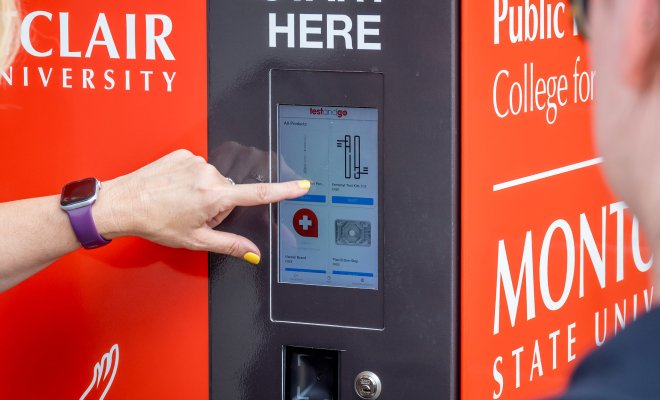
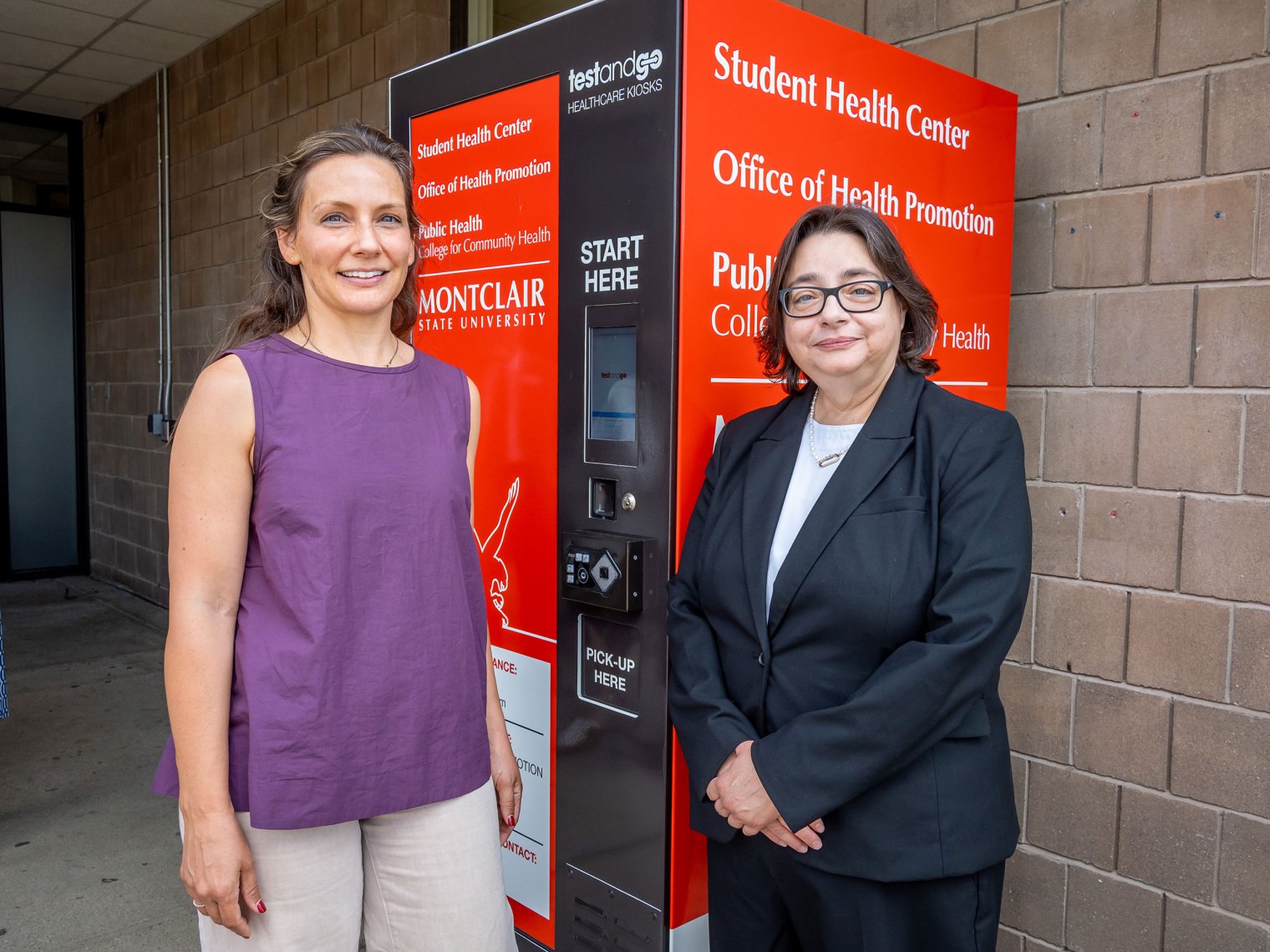
Assistant Director of Health Promotion Marie Cascarano shows how the Harm Reduction Kiosk works and some of the items available. (Photo by University Photographer Mike Peters.)
Key Takeaways:
Offers 24/7 anonymous access to essential health supplies for students, faculty and staff.
The Harm Reduction Kiosk is among the first, if not the first, on a college campus in New Jersey.
Effort was funded in large part by $26,000 in opioid settlement funds from Montclair Township
Montclair State University has introduced a new Harm Reduction Kiosk outside the Student Health Center to give students and the campus community easy access to essential health supplies without judgment. It’s free, anonymous, available 24/7 and believed to be among the first on a New Jersey college campus.
Delivered in July, the large, red vending-machine-like kiosk dispenses items such as safer sex kits, Narcan and drug-testing strips, marking Montclair’s latest commitment to student health, safety and well-being. Already it has proved to be a welcome addition.
“We dispensed upwards of 200 items even before the first day of classes,” says Student Health Center Director Sarah Jennings. “We're all about harm reduction, reducing barriers and providing access and making sure students don't feel judged.”
Charlie Cange, director of Montclair’s new Center for Harm Reduction, says there appears to be a need for supplies and praised the addition of the kiosk. “It makes harm reduction easily accessible to those who may need it. We are excited to be associated with this effort with the Student Health Center and Montclair Township. In the future, perhaps we will add other items that can help address other health issues, such as vaping.”
Removing Stigma, Prioritizing Care
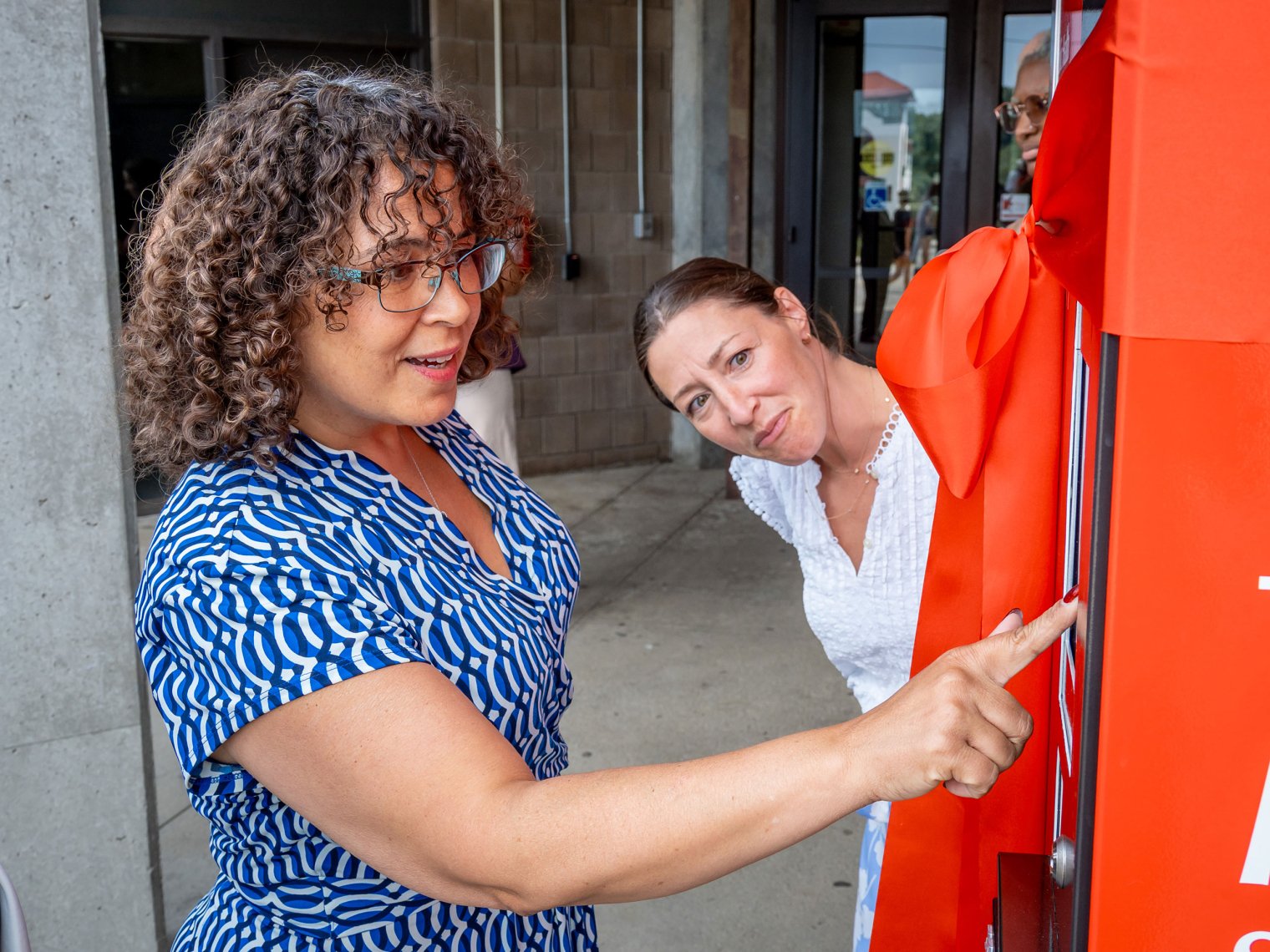
Montclair Student Government Association President Ben Coulson says he saw the kiosk being installed and decided to examine further; he found it easy to use. “It's absolutely a great installation to have on campus,” he said, noting that he’s seen students using it. “It shows that the University is caring for its students. By providing these products, they’re saying, ‘Here are tools that can help you be a safer person’.”
Public Health Department Chair Stephanie Silvera says, “The whole point is that students who come here don't have to talk to anybody. Nobody knows what they’re getting, and there's a whole plethora of things that they can get. They can get what they need without any fear of being embarrassed. There's no stigma.”
Most Requested Items
Data indicate that the most dispensed products include in descending order:
- Emergency contraceptives
- Safer sex kits
- Narcan
- Fentanyl test strips
- Spiked drink test kits
- Xylazine test strips
Complementing Existing Campus Resources
While many of these health products remain available in person at the Office of Health Promotion’s Drop-In Center, the new kiosk fills critical gaps: it operates 24/7 and requires no student ID or interaction.
“The kiosk provides accessibility when our office is closed – after hours and on weekends,” explains Assistant Director of Health Promotion Marie Cascarano. “It gives students the anonymity they may want while expanding access to essential harm reduction supplies.”
How the Kiosk Came to Campus
The Harm Reduction Kiosk was made possible in large part to a $26,000, two-year contract paid for by Montclair Township using opioid settlement funds. This marks the latest collaboration between Montclair Township’s Department of Health and Human Services and the College of Community Health’s Department of Public Health, which in 2024 established the first Academic Health Department in New Jersey.
While products can be obtained anonymously, users are given the option of providing some basic demographic data. Thus far, the data show that more undergraduate students are using the products, followed by graduate students, as well as faculty, staff and community members.
“Data collection is an important piece of it because you want to know who's using it, and what isn't being used too, and where there's gaps,” Monaco says.
“This isn't just a nice thing to have on campus; it's a need to have.”
~ President Johnathan Koppell
Leadership Support and Official Launch
A kickoff with students is set for 2:30 p.m. on October 1. During a ribbon-cutting ceremony held with Montclair Township officials this summer, Montclair President Johnathan Koppell noted that the delivery method is as important as the available resources and thanked both health departments for “continuing to find creative ways to serve our students.” He praised township officials for recognizing that “the healthier our students are, the healthier the town is.”
Koppell and Montclair Mayor Renee Baskerville, a former pediatrician, agreed that the kiosk ensures that health access and resources are available to all students, regardless of finances.
“It’s wonderful because I know also that not all students are able to afford some of these things,” Baskerville said.
Products such as the fentanyl test strips, xylazine and other drug test kits were supplied by Montclair Township, while Narcan is supplied to the University by the State of New Jersey.

- Published
- Author
- Sylvia Martinez
- Photographer
- MIke Peters
- Type
- Topic
- School or College