Alumni Spotlight: Nathaniel Frissell
Research scientist and professor Nathaniel Frissell ’07 began his Montclair journey with a passion for music and a hobbyist’s enthusiasm for ham radio. Today, Frissell’s research is deepening our understanding of the way radio waves travel through earth’s upper atmosphere.
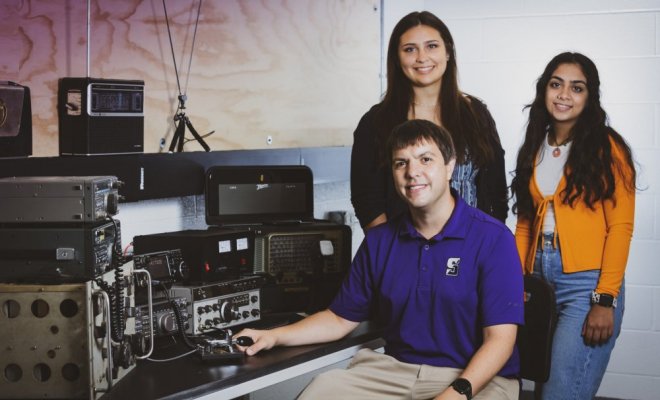
Nathaniel Frissell ’07, assistant professor of physics and electrical engineering at the University of Scranton, made the news recently. As the lead principal investigator of a $399,211 National Science Foundation (NSF) funded collaborative research project, he will be exploring “Measuring Daily Ionospheric Variability and the 2023 and 2024 Solar Eclipse Ionospheric Impacts Using HamSCI HF Doppler Shift Receiver.”
“I’ve been very fortunate," says Frissell. “Since 2019, I’ve received over $3.3 million in NSF, NASA and Amateur Radio Digital Communications (ARDC) funding.”
At first glance, the space between Frissell’s early years as a Bloomfield High School marching band and choir member, ham radio enthusiast, and dedicated Boy Scout, and his current role as a research scientist, might seem like a stretch of the imagination. But passion, hard work and his undergraduate years at Montclair State University blazed a most fascinating career path.
“I was trying to decide between a music-related degree and electrical engineering,” Frissell recalls. “Dr. Mary Ann Craig, Montclair’s Director of Bands at the time, visited my school. She did a great job recruiting. In fact, she was the main reason I chose Montclair, declared a Music Education major and joined the band.”
Frissell remained involved in ham radio and scouting, teaching electronics and radio technology to summer campers at New York’s Forestburg Scout Reservation. He found himself thinking more and more about electrical engineering, but he was already two years into his Music Education program, and he didn’t want to leave Montclair for an engineering school. “One of my Montclair mentors suggested I change my major to Physics, and then study electrical engineering in graduate school,” he says.
He paid a visit to Mathematical Sciences professor Mary Lou West. “I just knocked on her door and asked if I could become a physics major,” Frissell says with a laugh. “And she said sure!”
“West encouraged me to consider a double major,” he says. “It meant two extra years of undergraduate work, but it would be worth it.”
After completing his undergraduate education at Montclair, Frissell pursued electrical and computer engineering, earning a Master’s of Science and a doctorate from Virginia Tech; but his enthusiasm for research was sparked at Montclair. “The physics program opened my eyes to what it means to be a research scientist,” he says. “Dr. West brought me to my first professional conference, which was organized by the American Astronomical Society. I also presented a poster and won my first research-related award at the University’s Sigma Xi on-campus research conference.”
Student research was, and continues to be, an important aspect of the physics program at Montclair. “We have always looked for opportunities to help students learn how to turn information that you don’t understand into something that makes sense,” says West, who is now professor emerita of the University’s Department of Physics and Astronomy. “We help students think realistically about what they just measured.”
Frissell, who was a post-doctoral associate then an assistant research professor with New Jersey Institute of Technology for three years, joined University of Scranton in 2019. In his role, he is fortunate to still work with West, who collaborates on multiple research projects and helps advise his research students.
Drawing on his early experiences with research at Montclair, Frissell’s NSF project will involve University of Scranton students as well as collaborators at Case Western Reserve University and volunteers across the nation. Together, they will monitor the effects of dawn, dusk, and solar eclipses on the electrified portion of the upper atmosphere known as the ionosphere.
“These days we are accustomed to worldwide communication through digital and internet providers,” Frissell explains. “But high frequency (HF, 3-30 MHz) radio doesn’t require providers. With HF radio communication the atmosphere, the natural environment, is the provider.”
“The ionosphere causes HF radio frequencies to propagate around the curvature of the earth, allowing radio signals, and therefore communication, to span the globe,” he continues. “But the ionosphere exists primarily because of ultraviolet light from the sun. Our research will help us better understand what happens to radio signals before, during and after an event that affects the path of light from the sun to the earth.”
Frissell and his team are preparing for two such events in particular, an annular solar eclipse in October 2023, in which the edge of the sun remains visible as a bright ring around the moon, and a total solar eclipse in April 2024. And the pressure is on: These are the last solar eclipses that will be visible from the continental U.S. until 2044.
“What we learn about the upper atmosphere and how it works will help us, and other researchers, design better communications systems,” Frissell says.
Although his research – which has involved travel to locales as far away as Antarctica – is demanding, Frissell occasionally has the opportunity to take a drive through campus to reminisce about his Montclair years. Among the highlights was the opportunity to perform on stage with the innovative string ensemble, the Kronos Quartet.
“They were scheduled to give a concert at Montclair,” Frissell says. “The musicians were very interested in short-wave radio stations and wanted to incorporate radio sounds into their music. I played ham radio during their performance.”
Whether through music or radio technology – or both, Frissell’s interest remains where sound and science enable communication and provide opportunities to build community. Frissell founded and is the lead organizer of the international citizen science space physics research collective known as the Ham Radio Science Citizen Investigation (HamSCI.org). HamSCI is recognized as an official NASA Citizen Science Project.
He also organized the Solar Eclipse QSO Party, a nationwide ham radio experiment to study the August 2017 Total Solar Eclipse, and maintains an ongoing collaboration with the amateur radio electrical engineering organization TAPR to develop a Personal Space Weather Station. For his efforts, the amateur radio community awarded him the prestigious 2017 Yasme Foundation Excellence award, the 2019 Dayton Amateur Radio Association Amateur of the Year Award, and he was inducted in 2021 to the CQ Amateur Radio Hall of fame.
“Radio signals allow us to send and receive sound around the world,” he notes. “What could be more exciting?”
Frissell’s expansive life experience guides his sound advice: “Whatever your interests are, pursue them. It may take extra time, but it will be worth it. You never know where you’re going to end up!”
- Published
- Type
- Topic