
Teaching with AI: Tips and Ideas
AI-rich environments are reshaping how faculty think about course design, learning goals, assessment, academic integrity, and ethics. They also bring renewed urgency to perennial pedagogical questions, including how to foster meaningful student engagement and connect disciplinary learning to professional practice and real-world contexts. As AI becomes more integrated into academic and professional work, faculty also play an important role in practicing responsible data use and helping students develop the data privacy and security habits needed to use AI safely.
Best Practices for Safe AI Use
- As you might already know, not all data faculty can access and handle at work is public, and the distinctions are sometimes tricky. If you are unsure whether specific data can be entered into AI systems, please refer to Data Classification and Handling policy.
- When possible, use institutionally licensed tools for work tasks. As of August 2026, Google Gemini and MS Copilot are licensed to be used with data protection for users with Montclair login credentials.
AI and Learning Outcomes
As faculty adapt their teaching to AI-rich learning environments, the principles of effective course design remain unchanged. As you work on identifying the areas of your teaching practice that can be re-envisioned or adjusted for increased student success, it can be helpful to start with the learning outcomes. The impacts of AI on different disciplines, as well as on different courses within the same discipline, can vary greatly, so it is essential to reexamine the learning objectives critically, with these questions and considerations in mind:
- what constitutes must-know foundational knowledge and skills for this course and this discipline;
- what tasks are typically supported by or outsourced to AI tools in professional practice;
- what tasks have a high learning value for the students enrolled in this course, even if these tasks may be automated or AI-supported in professional practice.
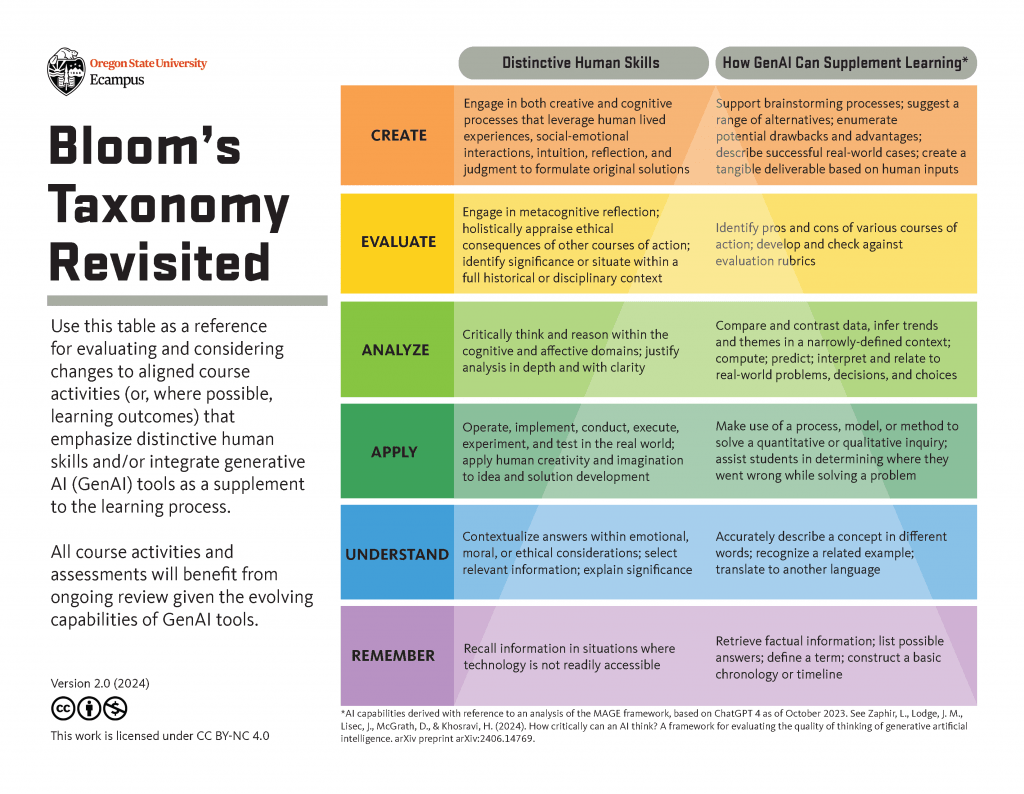
Frameworks such as Oregon State University’s “Bloom’s Taxonomy Revisited” can help guide faculty in considering how student learning outcomes are changing in the age of AI.
AI for Teaching and Learning: Disclose and Explain
Disclose and explain how you use AI to support your teaching. Setting an example of disclosing and explaining impactful AI use would be extremely educational for students, modeling professional behavior and ethics around AI use for them.
- Remember that automatic AI detectors are also AI systems. While their suggestions are not always reliable and often would not be accepted as strong evidence of inappropriate use of AI, it is understandable that many faculty still turn to them.
- If you choose to use a digital platform to support detection of AI use, make sure that your process remains FERPA-compliant and no personally identifiable information for any students is entered into third-party tools without institutional license.
- We recommend that you explain this part of your assessment process to your students prior to entering student submissions into any AI-detecting systems.
Assignment Strategies
Designing Effective Assignments and Assessments
One of the primary challenges AI poses for learning assessment is the obfuscation of the connection between product and cognition. A student submission, however advanced, no longer represents learning consistently and reliably. This problem is not fundamentally new, as dishonest learning and presenting others' work as one's own existed at all times. However, in AI-rich environments the scale of this possibility is magnified immensely, as the option to generate a submission within seconds is available, in some form, to most if not all students.
- Distinguish between formative assessments of skill development and the summative assessment of "must-have" knowledge and skills. Varying degrees of AI resistance can be needed for those distinct scenarios.
- you can use assessment add-ons like problem-solving logs, exam wrappers, minute papers, “muddiest point” questions.
- Assess process and process reflection in addition to product. A 3-5 minute process presentation, recording, or conversation with students can be a good way to measure learning, complementing a short essay or another project deliverable.
- Engage diverse media. Replace an essay or short-answer writing assignment with one that requires students to submit an audio file, podcast, video, speech, drawing, diagram, or multimedia project.
- For synchronous courses, flip the classroom. Reserve classroom time for creating and other hands-on work that can be assessed.
- Homework can also build on students' classroom experience for greater AI resistance. Ask your students to reference class materials, notes, or conversations.
- For example: “Refer to two of the theorists discussed in class.”
- Homework can also build on students' classroom experience for greater AI resistance. Ask your students to reference class materials, notes, or conversations.
- Scaffold the assessments. In many cases, academic dishonesty happens due to a time crunch. Teach and model good project management habits by assigning smaller, more frequent submissions instead of a single large one.
- For example: instead of one large submission due on May 5th, try assigning a project outline due April 1st, notes on research articles due Apr 15, first draft due Apr 25, and final draft due May 5th.
Strategies for Manageable Grading
- Ensure that assignments and submission requirements are aligned with the learning goals. For some courses and learning goals, it may be consistent and even essential to assign longer written pieces for summative assessments. In other courses, extended written work may often be assigned traditionally or conventionally, while there are other authentic ways to assess.
- Presentations or process discussions can be done in small groups (2-4 people). Being able to work with others became a crucial human skill in the age of AI.
Learn more: Assignments & Assessments
Encouraging Reflection and Learning
- Ask your students to reflect and plan as part of learning. Reflecting and envisioning a future are two areas where generative AI’s performance remains quite weak. Create space for reflection and sharing after each learning unit. Make reflection and planning a routine part of written assignments that is gradable. Students will not be able to create strong submissions for such tasks using generative AI (also, feel free to tell them just that!)
- For example: instead of the traditional essay, which may now be easy to cheat through, assign a multimedia project accompanied by a brief self-reflective essay.
- Reward trying as well as producing. If a perfect product (test, paper) is the only way to receive an A, students are more likely to resort to cheating. Make sure you assess and reward the processes that are needed to be a strong learner in your course: reading, viewing, speaking, improving, reflecting on one’s learning, etc.
- Review your grading criteria and rubrics to make sure you’re setting your students up to adopt strong learning strategies. See Grading for Learning under Plan for Grading.
- Employ Simple Active Learning Strategies: In-class and in homework, active learning assignments inspire learning.
Fostering AI Literacy in Your Classroom
As suggested by the results of the Employer Survey, conducted in the Spring 2026 by the AI Working Group with the support from Montclair Career Services, workforce competency expectations extend far beyond prompting skills. Graduates and new employees are expected to be able to engage with AI tools safely and ethically, as well as to leverage such tools for increased productivity. At the same time, distinctly human skills such as clear communication, critical thinking, project management, and disciplinary preparedness, remain essential for professional success.
Montclair has adopted the Definitional Frameworks for Foundational, Intermediate, and Advanced AI Skills to help guide faculty, staff, and students in the definition of AI literacy. To support these skills in the classroom, faculty can:
- Set clear course AI policies and expectations for assignments.
- Starting from Fall 2026, the Montclair Syllabus has a required field that faculty need to fill out, outlining expectations for student use of AI in each course.
- Teach students to use generative AI safely. Teach your students to never share personally identifiable, sensitive, or financial information, as well as any login credentials, with AI platforms that are not licensed by the University.
- Teach students to examine AI outputs critically. It is instrumental for students to understand that AI artifacts do not always meet the criteria of successful work as it can be defined by the university or by the workplace, and that AI artifacts require human verification, competent oversight, and ethical responsibility at all times.
- Model and suggest ethical uses of AI: personalized tutoring, feedback generation, team planning, scheduling, (public) data analysis.
- Teach students to cite generative AI correctly.
Increasing Student Engagement
- Assign social annotation. For short reading responses, instead of using open-ended questions in Canvas, try social annotation tools that require students to engage with a text along with their classmates. Try Hypothes.is or Perusall, both of which are supported by the University.
- Extend Flipped Learning: Ask students to read, view, and digest material at home, and then apply, demonstrate, and perform in class.
- For example: Have students write responses in class. If students have 20 minutes to write brief responses to the kinds of questions you might have provided as homework, they will learn a great deal, and as a bonus, your subsequent class discussion will benefit from that engaged individual work.
- Have students respond orally, requiring each student to respond to a different question.
- Have students work in small groups in class to present on topics in class.
- Incorporate brief in-class quizzes, tests and other assessments. The key is to make these short, frequent, and possibly even unannounced. They serve assessment purposes, reward attendance, and provide useful immediate feedback about learning. Small point values for individual assessments allow poor performance to be informative to students rather than disastrous.
- Engage visuals: ask students to respond to images or videos in their assignment. Be sure to include alt-text for accessibility.
- Collaborative Learning: Sometimes called team or group learning, collaborative learning can be designed to accelerate learning.
- Try requiring handwritten responses where scope permits. Students will groan, and you may too as you attempt to read student handwriting again, but not only will this deter the use of ChatGPT, but some research shows that we actually remember better when we write by hand. Varying the way we engage with thinking has value as it plays to different students’ preferences, and stretches all of us to try new ways to help us focus on the task of thinking.