Academic Department

Department of Physics and Astronomy

  • College of Science and Mathematics

Physics is a difficult subject, and pursuing a physics degree will require more than just a passing interest in physics or astronomy. You will be expected to work hard and dig deeply into the subject. If you are up for the challenge, we hope you’ll consider joining our department. There are many advantages of studying Physics with us. Our faculty size and number of majors allows for small classes and individual attention. Here, your professors will know you. There are multiple opportunities for research with faculty, including as part of a group focused on the LIGO gravitational-wave detector, which helped discover the first black hole collisions and led to the 2017 Nobel Prize in Physics. Our active Physics Club connects you with other physics majors, weekly activities, and free food! Our recently revised curriculum provides excellent preparation for STEM careers or graduate study. Recently renovated lab spaces have state-of-the-art new equipment: learn about atomic/nuclear physics, optics, and more! Two seminar courses prepare you for the physics major and set you on the path for post-graduation success. Our students have a strong track record of acceptance to graduate schools, landing top high school teaching positions, and corporate employment. Multiple degree paths provide a range of options suited to your talents and interests.

Physics and Astronomy
973-655-7794
Richardson Hall room 213
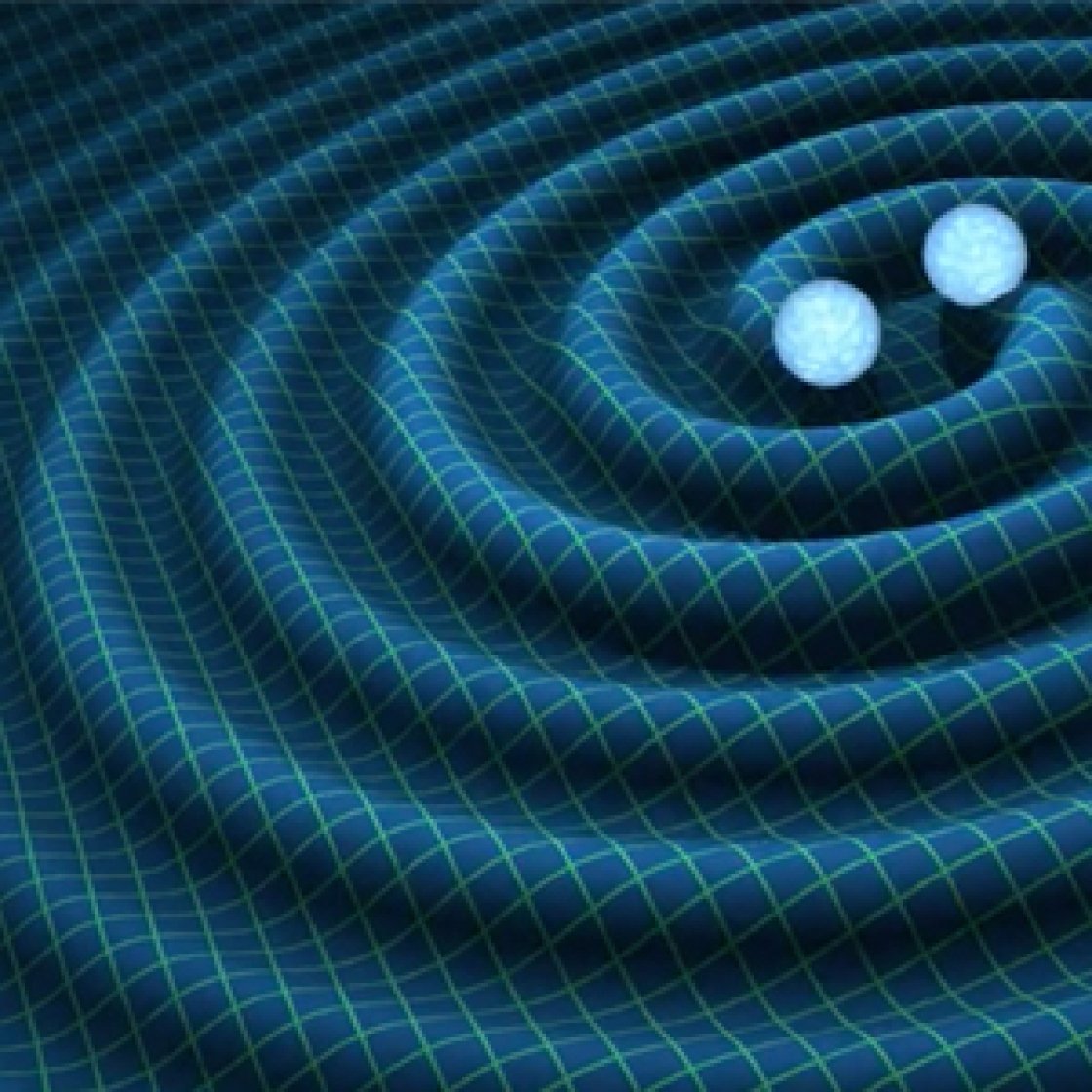
gravitational wave simulation

Physics is awesome!

From the big bang and black holes to atoms and photons, Physics and Astronomy are about studying nature on a fundamental level, from scales large to small. Curious about how the world works? Interested in gaining an incredible skill set that will make you attractive to a wide range of employers? Join us!
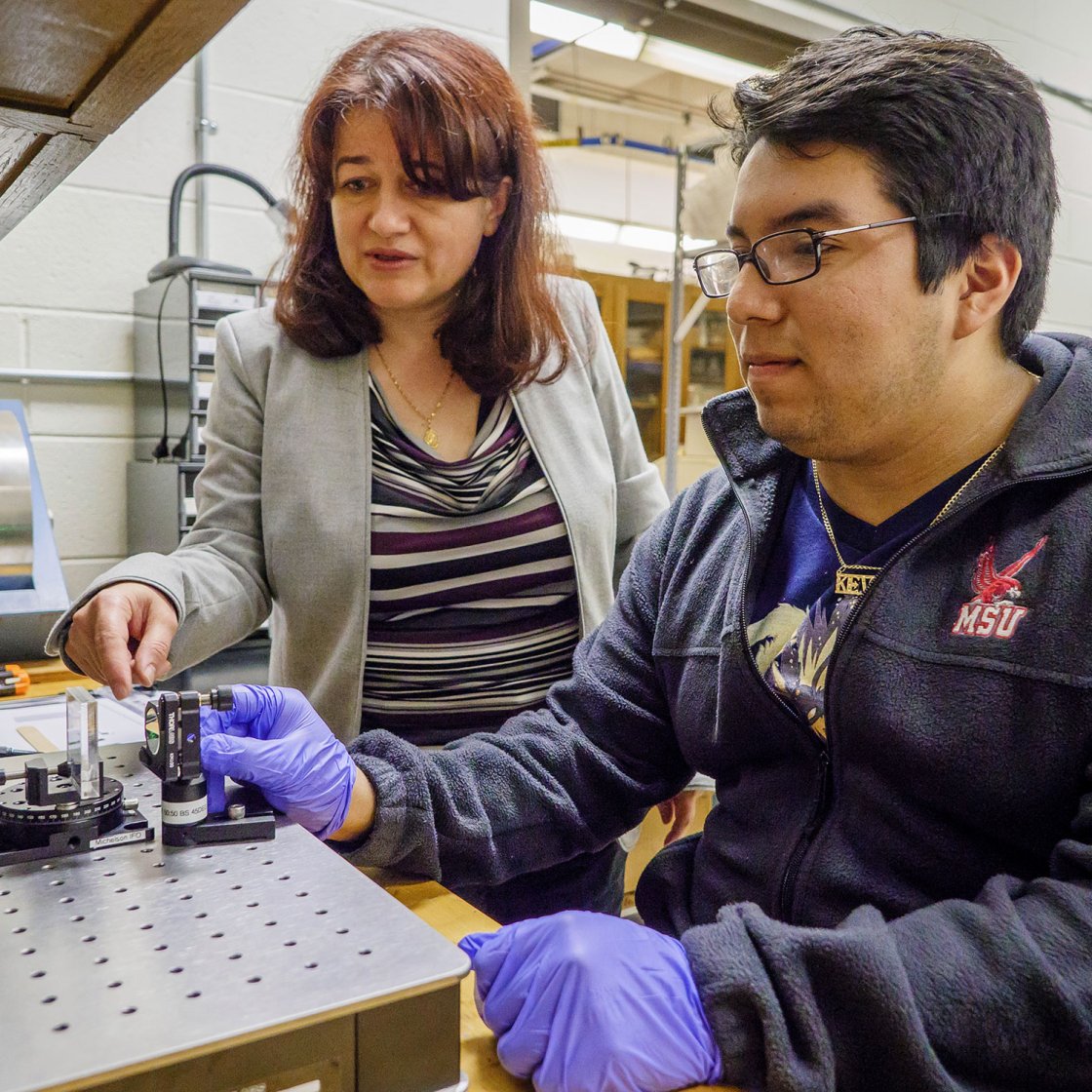
professor working with student on research

Research

Department research includes gravitational waves, fluid mechanics, experimental optics, astrophysics, and science education. Student research opportunities are available. Learn more about what our faculty specialize in below, and get involved!

Our Research Areas

Optics is the study of how light propagates. Our experimental optics lab (Rodica Martin) focuses on studying magneto-optic effects in various materials, with applications to the construction of Faraday isolators. We are also involved in computational modeling light scattering in interferometers. These topics are directly relevant to the construction of the Advanced LIGO detector, and will also be important for the next generation of gravitational-wave interferometers.

The nucleus at the center of the atom contains protons and neutrons. Nuclear physics concerns the composition of these particles, the forces that hold them together, and changes in their configuration via nuclear reactions. The proton and neutron are themselves composed of smaller (fundamental) particles called quarks. In our low-energy nuclear physics lab (currently under construction), Kent Leung is building components for an experiment that will measure the electric dipole moment of the neutron. That experiment (at Oak Ridge National Labs) will help test physics beyond the current Standard Model of particle physics. It will answer questions about the fundamental asymmetry between matter and antimatter in the universe, and also constrain certain theories of dark matter. Collaboration with another experiment at Duke University will measure the electric and magnetic polarizability of the neutron. These measurements will help test the theory of the strong interaction, quantum chromodynamics (QCD).

Science education and outreach is a significant part of our department’s activities. We are actively involved in education and outreach on behalf of LIGO, including the Sounds of Spacetime project (Marc Favata), organizing exhibit booths on gravitational-wave science, and the development of student lab activities related to interferometry and gravitational-wave detections (Martin, Favata).  Other activities include the study of problem solving methodologies and the use of social media and the latest neuroscience research to improve introductory physics instruction (Dean Hamden). We also work with high school students through the Weston Science Scholars program.

Why Study Physics

Physicists attempt to understand the fundamental mathematical relationships that govern natural phenomena and apply those relationships to interesting problems. The main reason to study physics is because you are curious about how the world works. In addition to that knowledge, you gain a set of incredibly useful skills that make you attractive to a wide range of employers.

A physics degree trains you to become an expert problem solver. You will learn to break down a problem into its component parts and apply advanced mathematics, computing, data analysis and experimental techniques to arrive at a solution. We also emphasize technical writing and presentation skills, as well as working in teams.

Physics majors are well-prepared for further graduate study in physics or astronomy, or employment in a wide-range of sectors including:

  • Engineering and manufacturing
  • Computer programming/software design
  • Finance and management consulting
  • Defense and aerospace industry
  • High school science teaching
  • Journalism or science writing
  • Law and government
  • Medicine
  • Physics & Astronomy research

Employers understand the strong analytical skill set that physics majors bring; physicists get good job offers with salaries comparable to engineering and computer science majors. Among all disciplines, physics students have among the very highest average scores on the MCAT and LSAT examinations, indicating that a physics degree also provides excellent preparation for law and medical school.

One of the oldest academic disciplines, physics is a natural science whose goal is to understand how everything works at its most fundamental level. Physicists study nature on scales as small as an atomic nucleus to as large as the observable universe. Physics is the cornerstone of the other natural sciences (chemistry, geology, biology, astronomy) and is essential to understanding our modern technological society. At the heart of physics is a combination of experiment, observation and the analysis of phenomena using mathematical and computational tools.

Examples of what physicists study include:

  • The nature of fundamental particles (protons, quarks, electrons, neutrinos,…).
  • The behavior of dark matter, dark energy, galaxies and black holes.
  • The properties of matter in standard and exotic phases (solids, liquids, plasmas, superconductors, superfluids…).
  • The behavior of complex systems (the stock market, cellular locomotion, infectious disease transmission, the motion of galaxy clusters or distant planetary systems).

There is an extreme shortage in New Jersey of high school teachers with physics training. Physics majors become well-qualified to teach not only physics but also geoscience, chemistry and all levels of mathematics. Our graduates regularly get attractive offers from excellent high schools in the region. Learn more about becoming a physics teacher at the links below: