
About Us
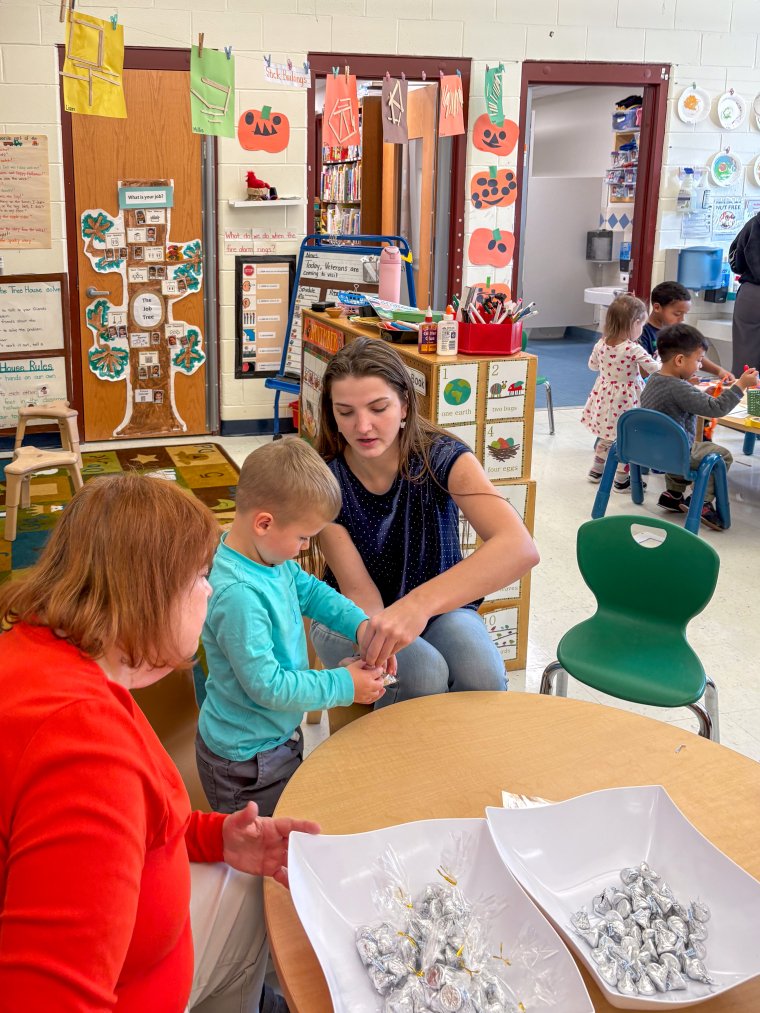
At Ben Samuels, we believe every child deserves a place to learn, play, and grow. Learn more about who we are, what we believe, and the history that brought us here.
Our Mission
The dual mission of the Ben Samuels Children's Center at Montclair State University is to be a model of excellence in inclusive early care and education for children from birth through five years, and to provide outstanding teaching and learning opportunities for future educators and therapists.
In support of this mission, we have created a community where:
Children of differing abilities, needs, cultures, ethnicities, means and family structures are provided with developmentally appropriate activities and services, and where families, staff and university students understand and embrace the value of that diversity.
Families of children enrolled in the Center are provided with support, assistance, and resources in the care and education of their children.
Future generations of professionals who care for children are educated through research, observation, and hands-on experiences of the best practices in early childhood education and development in an inclusive environment.
Center faculty and students engage in observation and reflection relating to child development, early education, inclusive learning, and other related areas.
Our History
The Ben Samuels Children’s Center, which opened in September 2005, brought together three longstanding and proud programs:
The process of bringing these programs together began in 1994, when a faculty group studying inclusive education received a grant from the New Jersey Network for Educational Renewal. Their work led to a recommendation to create a premier inclusive early childhood facility at Montclair State. With support from university leadership, The College of Education and Human Services, The Center of Pedagogy, and the University Foundation, Ben Samuels Children's Center opened its doors in September 2005.
The Child Care Center was opened in Feb 1989 under the Division of Student Development and Campus Life primarily as a service for the students of the University. The original Child Care Center was a one-room schoolhouse serving 20 children ages two and a half to six years of age. As the need for additional child care services became evident, the Center grew and expanded to meet those needs. It became a recruiting and retention tool for attracting students, faculty and staff to Montclair State University and began providing early care and education employment opportunities for Montclair State University students, as well as observation and fieldwork opportunities for students majoring in education.
The Demonstration Program began in the late 1960s when the Department of Communication Sciences and Disorders saw an educational need for children who had severe communication disorders. It was influenced by the fields of speech-language pathology and learning disabilities as it pioneered cutting-edge practices, and encouraged the community to do the same. By 1990 it was providing special education for three to five year olds with significant communication and regulation disorders. Many of these children showed developmental patterns that were consistent with the spectrum of autism. This strongly transdisciplinary program was influenced by the Developmental, Individual-differences, Relationship-based (DIR) approach developed by psychiatrist Stanley Greenspan and psychologist Serena Weider who were in turn influenced by occupational therapist and psychologist Georgia DeGangi and others.
The Jeffrey Dworkin Early Intervention Program began in 1981 when the Department of Communication Sciences and Disorders saw the need to extend the work it was doing to children under the age of three. By the late ’90s it was providing early intervention services to families in western Essex County in their homes and in other places where very young children and their families typically spend their time. This program was influenced by the field of early intervention that, as a whole, stresses family-centeredness, consultative transdisciplinary practices, and working in the naturally occurring environments and routines of families.
Our Philosophy
Our philosophy is rooted in decades of research on child development, inclusive education, and early learning. We believe every member of the Center community — children, families, staff, and university students and faculty — is poised for growth, and that we grow together through collaborative inquiry, reflection, and nurturing relationships. At the heart of our approach is a play-based curriculum where daily activities emerge from children's natural interests, building curiosity, social-emotional skills, and a love of discovery.
Diversity & Inclusion: BSCC embraces diversity – differing needs, abilities, cultures, ethnicities, means and family structures – and understands that it is crucial for the healthy development of individuals, organizations and our society. We believe all children have the potential to and are capable of learning. We are responsive to the unique, biologically based way each individual takes in, processes, and responds to the world. We are committed to providing access, supporting participation, and providing appropriate supports to ensure all children are fully engaged members of the classroom and center community.
Relationships: Trusting, positive relationships with other children and with experienced, caring adults contribute to each child’s sense of self-worth and belonging. BSCC utilizes a tiered, evidence-based framework for promoting young children’s healthy social, emotional, and behavioral development called the Pyramid Model. This public health approach provides universal support for all children, including nurturing, responsive relationships and high quality environments. It also assists teachers and families with targeted social emotional support and individualized interventions when needed.
Emergent Curriculum: Curriculum emerges out of what children and other members of the community bring to the Center. BSCC utilizes the HighScope Curriculum, a research-based early childhood education framework emphasizing "active participatory learning". Children learn through direct hands-on experiences with people, objects, and ideas, developing independence, problem-solving skills, and a strong academic foundation. Our curriculum explores, extends and builds on their interests and experiences to help children gain new insights through project based work.
Transdisciplinary Model – Our approach to early childhood education views learning and development as a holistic, interconnected experience. Our staff consists of educators, speech-language specialists, occupational and physical therapists and music therapists who collaborate together and partner with families to plan, support, and assess each child. This approach uses insight from these interrelated areas to maximize children’s growth and success .
- Constructivism
- Developmentally Appropriate Practice (DAP)
- Early Childhood Inclusion
- Developmental Individual-Differences Relationship-Based Approach (DIR®/Floortime)
- Deweyan Democratic Education
- The Reggio Emilia Approach
- Multiple Intelligences