PhD Student Receives Multiple Awards for Her Work and Research
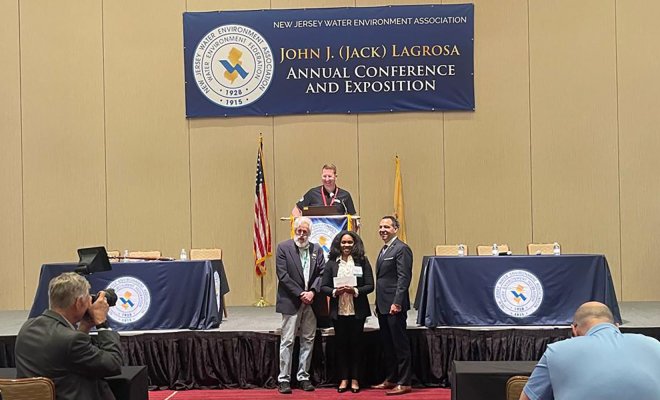
Hilda Afeku-Amenyo receiving the Dr. Raymond M. Manganelli Scholarship Awards from the New Jersey Water Environment Association (NJWEA).
Hilda Afeku-Amenyo recently received awards from two organizations. She credits her advisor, Dr. Pankaj Lal, for guiding her work and encouraging her to ground the financial design in measurable ecological data and to test the framework against real New Jersey conditions. His feedback on my proposals and his support through the application process strengthened both submissions.
The Dr. Raymond M. Manganelli Scholarship Awards from the New Jersey Water Environment Association (NJWEA) supports high-achieving students in environmental science and engineering whose studies focus on water quality and environmental protection. The award recognizes students committed to careers in these fields, with the aim of bringing capable, well-trained people into the work of protecting New Jersey's water environment. I received the award for my research on measuring the health of New Jersey's coastal waters and wetlands and linking those results to the funding that pays for their restoration.
The New Jersey Chapter of the Society of Women Environmental Professionals (NJSWEP) Scholarship encourages women to pursue careers in environmental fields. It is awarded to promising graduate students in environmental and related disciplines and connects them with NJSWEP members for future internships and careers in the environmental industry. I received the award for my research on financing ecological restoration in lower-income coastal New Jersey communities and my commitment to a career in environmental policy. The award was presented at the 18th Annual NJSWEP Gala in June 2026.
The Department of Earth and Environmental Studies has given me the environmental science training that the measurement work depends on, and my colleagues have been generous with feedback in my research work.
My research is building a framework that connects the health of NJ ecosystems to the funding. The research develops an integrated framework for financing coastal restoration by linking environmental monitoring, performance-based bond design, and transparent public reporting. It uses measurable ecological outcomes to evaluate project performance, connects financing terms to verified environmental results, and improves visibility into restoration needs and funding gaps across coastal communities.
- Published
- Type
- Topic
- School or College