
Climate change and extreme drought in grasslands from local to global scales
Dr. Scott Collins, Distinguished Professor and Loren Potter Chair, Department of Biology, University of New Mexico, presents this seminar.
- Date
- Location
- Virtual Zoom
- Organizer
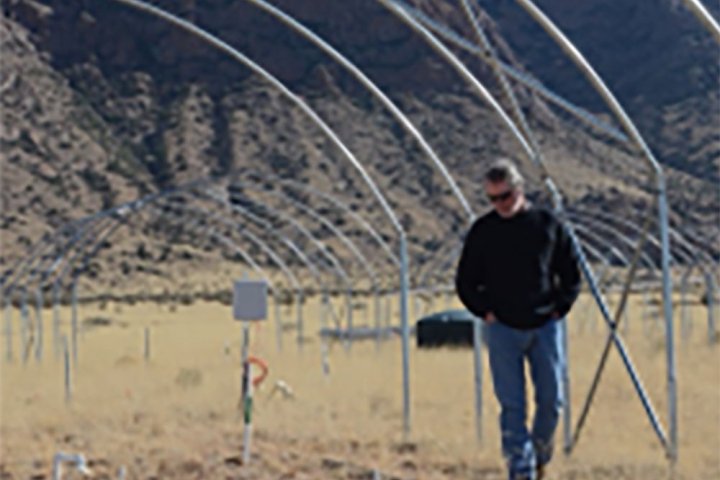
About the Speaker
I received my PhD from the University of Oklahoma in 1981. Following a postdoc at Rutgers University, I returned to the University of Oklahoma where I was an Assistant and then Associate Professor of Botany. In 1992 I moved to the US National Science Foundation where I served for 10 years as a Program Director in the Division of Environmental Biology managing a variety of funding programs. In 2003, I moved to the University of New Mexico where I am now Distinguished Professor of Biology and the Loren Potter Chair of Plant Ecology. I have served as Chair of the US Long-term Ecological Research (LTER) Network (elected). I have been Vice President for Public Affairs and President of the Ecological Society of America, the largest society of professional ecologists in the world. I was Editor in-Chief of the AIBS journal BioScience from 2016-2023 and am currently Editor-in-Chief of the ESA journal Frontiers in Ecology and the Environment. I am a Fellow of the American Association for the Advancement of Science, the Ecological Society of America and the American Geophysical Union. I have received the Distinguished Service Citation from ESA, and the Annual Research Lecture Award from the University of New Mexico.
Abstract
Climate models predict a future with more frequent extreme events, such as decadal droughts and altered rainfall seasonality. Collaborators and I have conducted observational and experimental studies of drought impacts in grasslands in South Africa, China and across the US Central Plains. In Kruger National Park, South Africa, a severe drought led to a “state change” from predominantly unpalatable to palatable grasslands but that state change depended on fire frequency. In the Southwestern US, we experimentally created a 7-year long extreme drought in Chihuahuan Desert and Great Plains grasslands. Dominant grasses declined at both sites during drought, but production recovered during the first year after drought ended. Similar responses, low resistance but high resilience, to extreme drought occurred in other US and China grasslands. Generally, subordinate species drove recovery, not the dominant grasses, highlighting the role of biodiversity for ecosystem resilience. Overall, I will discuss ecological drought, summarize insights from long-term experiments, and highlight the value of distributed, coordinated experiments to understand ecosystem vulnerability to climate extremes.
- Topic
- Audience