
PSEG ISS Green Teams
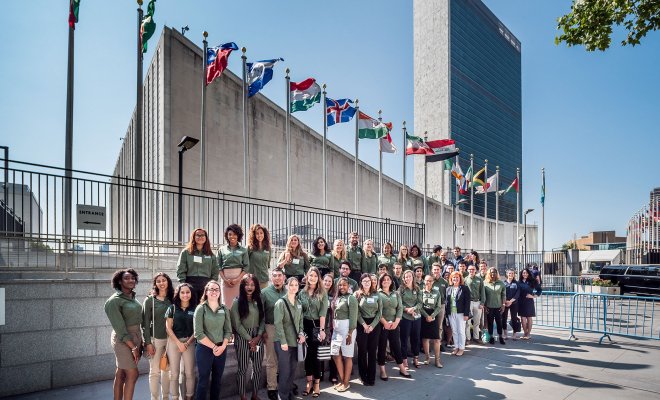
The Green Teams Internship Program was initiated as a trans-disciplinary internship program targeted to upper level undergraduates, exceptional rising sophomores may also be considered, from any discipline who are interested in sustainability. These teams of students serve corporations, organizations, non-profits, municipalities and community groups to address sustainability issues identified by the host organizations. Teams of five students are constructed from diverse applicants whose backgrounds match those required to achieve deliverables requested by corporations and organizations. PSEG ISS provides training throughout the course of the program in core sustainability subjects, hands-on experience with sustainability skills, guidance in professional development and communication, and team building. Students also participate in community service and go on several field trips throughout the summer, such as trips to the Princeton Plasma Physics Lab and the United Nations.
Teams make site visits to their host corporations at least once throughout the summer and meet weekly with company representatives to discuss the progress of their deliverables. Students are trained, and conduct the majority of their work, on site at Montclair State University under the supervision of a leadership team. They work intensely full-time each for ten weeks. At the end of the program, they present their work in a comprehensive written report to their hosting organization and give a group TED-style presentation to a broad audience.
As part of a Green Team, you could:
- Learn first-hand how businesses function.
- Become experienced in developing projects and creating deliverables.
- Understand and envision how sustainability intersects with your career trajectory.
- Establish a network for future internship and employment opportunities.
- Interact with local community members.
- Gain experience in applied science.
- Improve your communication and team-working skills.
- Gauge and improve company interactions with employees using surveys and marketing documents.
- Develop professional reports and presentations.
- Assess environmental impacts.
- Obtain eligibility for Leadership Certification.
For questions, please contact the PSEG Institute for Sustainability Studies at psegiss@montclair.edu
How do Green Team Interns feel about their experience?
What do our corporate partners and alumni have to say about the Green Teams?
Previous Green Teams
Information and Deliverables
ADP is global provider of cloud-based Human Capital Management (HCM) solutions. The company also provides clients with business outsourcing services, analytics and compliance expertise.
Project Summary
ADP asked its Green Team to identify, analyze and implement solutions to sustainability challenges at ADP. To assist ADP, it’s Green Team Produced the following deliverables:
- Developed a series of infographics to increase employees understanding of recycling and proper disposal of electronic waste.
- Created new template for the company’s monthly Green Newsletter, and wrote the company’s newsletters for the months of June and July.
- Developed guidelines and template for a new ADP website that communicates the company’s new and existing sustainability initiatives in a more engaging manner.
- Created a survey and reporting template for ADP sites to determine what Leadership in Energy and Environmental Design (LEED) standards they currently meet, and what criteria they need to fulfill in order to achieve full LEED certification.
- Created a database of grants and other external funding sources for ADP utilize when pursuing new sustainability initiatives.
The first hosting organization, AvalonBay Communities, has a long-term track record of developing, redeveloping, acquiring and managing distinctive apartment homes in some of the best U.S. markets, and delivering outsized, risk-adjusted returns to shareholders. With equal parts experience and vision, they’ve established a leadership position rooted in building value for the long term.
Deliverables
- Reporting:
- SEC / EU Taxonomy / TNFD
- Help map against frameworks listed above
- SEC / EU Taxonomy / TNFD
- Green Building:
- Embodied Carbon
- Help define embodied carbon goal based on competitors and industry organizations (CLF, WorldGBC, Architecture 2030, etc.)
- What are our competitors achieving / what goals are they setting
- Water Goals
- Provide consumption reduction opportunities outside of what has been completed
- Assist in developing path for meeting consumption-based water goal
- Biophilia/Biodiversity
- Competitor analysis / best in class approach
- Material Health
- Competitor analysis / best in class approach
- Embodied Carbon
- Resident Energy
- Green Energy options for Residents
- Provide lists of the programs/utilities that allow residents to purchase green energy directly
- Water Risk
- Current Climate Risk Assessment / WRI comparison
- Compare the 2 different risk overlays for similarities and differences to determine gaps or flaws in our current assessment
Bristol-Myers Squibb (BMS), a Fortune 500 global bio-pharma company that manufactures prescription pharmaceuticals in several therapeutic areas, including cancer, HIV/AIDS, cardiovascular disease, diabetes, hepatitis, rheumatoid arthritis and psychiatric disorders, has delivered 12 new medicines to patients in the past seven years, and has strong commitment to the preservation of natural resources.
Project Summary
BMS asked their Green Team to research innovative ways to increase employee engagement with existing and new sustainability initiatives at BMS. To achieve this goal, the Green Team provided BMS with the following deliverables:
- Developed an employee survey designed to provide BMS with insight into understanding and improving employee engagement with its sustainability program.
- Conducted a focus group to understand factors that would motivate younger employees to engage with BMS’ current sustainability initiatives.
- Proposed a redesign of BMS’ internal “Go Green Sharepoint” site to better promote the company’s sustainability initiatives amongst employees. This redesign included the implementation of interactive global maps that allow employees to view best practice initiatives at BMS sites around the world.
- Provided a competitor analysis of initiatives to promote corporate sustainability and improve employee relations.
The City of Newark Office of Sustainability was created in 2010 to address the looming effects of climate change and environmental injustice. Through community engagement, policy analysis and education, the office prioritizes four main goals. These goals include making Newark healthier, greener, more resilient, and cooler for its residents. By collaborating with other municipal departments, the Newark Environmental Commission, public/private stakeholders and residents, they effectively advance sustainability and climate resistance.
Deliverables
The City of Newark Green Team supported Newark’s Sustainability Action Plan by combining community engagement, data analysis, and spatial planning to strengthen green space access and infrastructure. Their work included the following deliverables:
- Community Outreach Efforts: Conducted stakeholder mapping, developed an inclusive outreach strategy, and implemented engagement tools (surveys, interviews, and community events) to gather diverse perspectives.
- Community Input Reporting: Analyzed and synthesized feedback to identify community priorities, needs, and barriers to green space access.
- Environmental and Social Analysis: Investigated factors influencing neighborhood conditions and green space equity using Newark’s Sustainability Action Plan and other relevant sources.
- GIS Mapping and Green Infrastructure Opportunity: Developed GIS layers to identify and visualize vacant lots and highlight spatial gap opportunities in green infrastructure, complementing Newark’s Sustainability Action Plan.
- Conclusive Tools: Produced an executive summary, visual materials, and presentations to communicate sustainability plan priorities with a focus on green space infrastructure, along with an action item timeline to complete the project.
Jersey City, New Jersey is one of the world’s most ethnically diverse cities. The Office of Sustainability was established in 2018 to oversee the City’s sustainability efforts. “The Office coordinates across departments to improve the City’s sustainability practices, research and implement new community sustainability policies, develop action plans for meeting the City’s climate sustainability goals, and interface with the community to raise awareness of sustainable practices and sustainability resources” (jcmakeitgreen.org). This is Jersey City’s third year participating with the Green Teams.
Deliverables
- Collected, measured, and analyzed outdoor temperature-related data for the City of Jersey City.
- Examined three areas in their analysis: the variability between neighborhoods on the intra-heat island effect, the impact of vegetation on temperature variability, and the relationship between income and heat distribution.
- Created heat maps and other maps using ArcGIS to visualize the data.
- Made recommendations for the City to address environmental inequity issues, including the implementation of vegetation donation programs.
Jersey City, located between the Hudson and Hackensack Rivers, covers nearly 15 square miles of land at the center of the New York City metropolitan region. Jersey City’s Office of Sustainability researches and implements new community sustainability policies, develops action plans for meeting the City’s climate sustainability goals, and interfaces with the community to raise awareness of sustainable practices and resources. This is Jersey City’s second year participating with the Green Teams.
Deliverables
- Made progress in accurately mapping and analyzing Jersey City’s street trees through the collection of various attributes of the trees such as latitude and longitude; species; health; diameter at breast height; and pit area
- Created estimates of carbon sequestration by the city’s trees, using an Infrared Gas Analyzer (IRGA)
- Made recommendations on communicating tree-related educational information to the public
- Developed a report and presentation that offers a strategic plan for improving the city’s tree canopy
- Created website dashboard
Jersey City, located between the Hudson and Hackensack Rivers, covers nearly 15 square miles of land at the center of the New York City metropolitan region. Jersey City’s Office of Sustainability researches and implements new community sustainability policies, develops action plans for meeting the City’s climate sustainability goals, and interfaces with the community to raise awareness of sustainable practices and resources.
Deliverables
- Analyzed greenhouse gas inventory of the city
- Calculated vehicle fleet emission
- Compiled a weatherization building plan
Newark is the largest city in New Jersey, with over 270,000 residents. Newark’s Sustainability Office “supports policies and programs that improve public health and quality of life, drive down costs through better stewardship of resources, and expand green job and business opportunities for Newarkers." This is the City of Newark’s fifth year participating with the Green Teams.
Deliverables
- Helped the City of Newark with tracking their sustainability progress and obtaining certifications.
- Focused on CDP-ICLEI and LEED for Cities and Communities.
- Identified areas of improvement for the City, such as its high land surface temperature and high area of impervious surfaces.
- Made recommendations for the City, including increasing Newark’s tree canopy by conducting tree mapping.
Newark is the largest city in New Jersey, with over 270,000 residents. Newark’s Sustainability Office “supports policies and programs that improve public health and quality of life, drive down costs through better stewardship of resources, and expand green job and business opportunities for Newarkers.” This is the City of Newark’s fourth year participating with the Green Teams.
Deliverables
- Worked on climate action for the City of Newark by gathering, organizing, and cleaning various energy-related data sets to better inform proposed actions
- Developed a greenhouse gas inventory using ICLEI’s ClearPath software, which included future forecasting carbon use scenarios and recommendations to reduce the city’s energy usage
- Created a map and dashboard as visual aids linking Newark locations to their associated energy consumption data
- Identified areas needing additional vetting of data sources, accuracy of available data, and missing data
Newark is the largest city in New Jersey, with over 270,000 residents. Newark’s Sustainability Office “supports policies and programs that improve public health and quality of life, drive down costs through better stewardship of resources, and expand green job and business opportunities for Newarkers.”
Deliverables
- Created a STEW-MAP to connect community organizations who exhibit environment stewardship
- Developed infographics, posters, and post cards worked to provide information related to Newark’s Sustainability Action Plan, with the goal of creating a clean, green, healthy, prepared, and engaged community
Newark is the largest city in New Jersey, with over 270,000 residents. Newark’s Sustainability Office supports the community through efforts in public health and business opportunities.
Deliverables
- Created a framework for GHG inventory
- Developed outreach materials for Newark’s Sustainability Plan
- Translated all documents related to the community into Spanish
- Generated a stewardship map for the city of Newark
Newark is the largest city in New Jersey, with over 270,000 residents. Newark’s Sustainability Office “supports policies and programs that improve public health and quality of life, drive down costs through better stewardship of resources, and expand green job and business opportunities for Newarkers.”
Project Summary
The City of Newark asked its Green Team to assist the city in the development of its 2018 Sustainability Action Plan. To assist the city, Newark’s Green Team produced the following deliverables:
- Administered a stakeholder engagement initiative to provide insight on sustainability initiatives the city should address in its 2018 sustainability report. Specifically, Newark’s Green Team:
- Created 93 focus prompts for stakeholders based on initiatives from the city’s 2013 Sustainability Action Plan, and evaluated these prompts based on their importance and feasibility to stakeholders.
- Clustered data into 12 sections based on stakeholder responses to focus prompts.
- Identified “low hanging fruit” (issues of high importance and high feasibility) issues for the City of Newark to immediately address.
- Volunteered at four Newark Sustainability Summer Series Events and provided recommendations for the city to increase further engagement with the city’s residents.
- Created a series of infographics on greenhouse gas, water usage, energy usage and waste disposal to display and additional city events throughout the year
The City of Paterson is the largest city in the county seat of Passaic County, in the U.S. state of New Jersey. Paterson has been known as the Silk City for its once-dominant role in silk production during the latter half of the 19th century.
Deliverables
The Green Team serving The City of Paterson focused on enhancing food accessibility and security in Paterson, NJ. The team conducted in-depth research on successful food programs, such as food policy councils, farmer’s markets, and urban gardens, in cities with demographics similar to Paterson. A comprehensive map was created to identify food deserts and various food sources within Paterson, including supermarkets, farmers’ markets, community gardens, bodegas, and food pantries. The map highlights areas in need of increased accessibility to healthy food. The team also performed a detailed audit of existing food policies, identifying opportunities for policy changes in ordinances, zoning, permitting, and procedures to enhance food accessibility, food justice, and resilience. Local food stakeholders and city officials were engaged through focus groups to assess their current actions, challenges, and capacity to contribute to developing a healthy food system. The team created outreach materials to promote existing farmers’ markets and community gardens in Paterson. These materials were produced in English and other languages spoken in the community to ensure broad accessibility.
The RWJ Cooperman Barnabas Medical Center is committed to the ongoing improvement of the health, quality of life, and vitality of communities. They strive to bring the best healthcare to meet the evolving needs of residents in New Jersey. RWJ Barnabas Health is advancing innovative strategies in high-quality patient care, education and research to address both the clinical and social determinants of health.
Deliverables
- Developed a baseline environmental assessment of specific areas within the medical center to inform sustainability strategies/practices.
- Developed inventory of types of environmental data available and source locations.
- Examined availability of emissions data.
- Develop a gap analysis for areas that data should be gathered in the future, with the intention of submitting to Practice Greenhealth.
- Conducted a competitor analysis.
- Outlined and began drafting a sustainability report.
Founded in 1907 and supported by three generations of the Cox family, Cox Printers was purchased by the Kaufman family in 1982. Cox Printers offers a wide range of services to its customers from off-set and digital printing to direct mail, signage and marketing.
Project Summary
Cox Printers asked their Green Team to provide solutions to reduce their carbon footprint, identify/develop a carbon calculator for present and future outputs, and establish environmentally sustainable partnerships with local community organizations. By the end of the summer, their Green Team produced the following deliverables:
- Calculated Cox Printer’s carbon footprint using carbon calculator developed at University of California Berkley, and provided an analysis of how Cox Printers’ footprint compares to similar businesses in its region.
- Recommended utilizing biodegradable shrink wrap as a new packaging solution, after conducting a cost analysis. Based on their results, Cox put an order to use this shrink wrap on future packaging projects.
- Developed two separate “green roof” proposals designed to reduce heating/cooling costs and overall carbon emissions, while increasing employee engagement with the company’s sustainability initiatives.
- Provided solutions to reduce electricity consumption and improve vehicle fleet efficiency.
- Proposed donating excess produce from the company’s green roof to a local food bank.
- Recommended purchasing Pyrex and Glasslock Containers for company kitchen to reduce employee waste consumption.
Dr. Glen O’Neil is an Associate Professor of Chemistry and Biochemistry at Montclair State University. Under his guidance and in alignment with his research in electrochemistry and chemical sensing, a Green Team was embedded in his lab to work on cutting edge and marketable hydrogen-related energy technology.
Deliverables
- Investigated membrane-less electrolysis cells for producing clean hydrogen for energy storage applications. The team’s deliverables focused on three aspects: engineering, chemistry, and marketing.
- For the engineering component, they performed iterative design of membrane-less electrolyzers using 3D printing including optimizing channel width, electrode size, electrode placement, and more.
- To complete their chemistry deliverable, they optimized catalyst loading for maximum device efficiency.
- Conducted market research and a Strengths, Weaknesses, Opportunities, and Threats (SWOT) analysis to determine the marketability of the membrane-less electrolyzer.
DSM-Firmenich, a Swiss-Dutch company, collaborates with businesses to deliver scents and flavors to over 4 billion consumers through a variety of products. Their expertise in science, innovation, and research has been developing for over 150 years, dating back to 1869.Formed by the merger of DSM, a leader in nutrition and sustainable materials, and Firmenich, a world-renowned fragrance and flavor company, dsm-firmenich focuses on creating innovative solutions for industries like food, beverages, dietary supplements, personal care, and fragrances. The company integrates scientific expertise with a commitment to sustainability, offering products that enhance health, well-being, and sensory experiences.
Deliverables
The 2024 Green Teams project began with the development of a project charter and a stakeholder map to define the project’s scope and objectives while identifying both internal and external stakeholders. The team then compiled a master list of all laboratories, detailing information such as location, type, and specific functions, to help monitor metrics for improvements. Current green lab performance was reviewed using a checklist of best and standard practices, which was tailored for each lab and implemented at the project’s conclusion. Key Performance Indicators (KPIs) were developed and company metrics were assessed to establish a framework for measuring crucial data such as water and energy consumption, and identification of areas that required adjustments to align with dsm-firmenich’s sustainability goals. Finally, the team created a “Green Labs Tips” page to be displayed in laboratories worldwide, featuring universal tips and tricks for enhancing lab sustainability in an easy-to-use format. In addition to completion of the deliverables, the team received certification from a nonprofit organization “My Green Lab” and began the base work for a chemical exchange program.
The family owned and operated Earth Friendly Products is a global manufacturer of environmentally friendly cleaning products. The company was established in 1967, and is known for leading the green cleaning industry with its ECOS Laundry Detergent.
Deliverables
- Tested wastewater chemicals
- Implemented wastewater treatment options
ECOS was established in 1967, and is a global manufacturer of environmentally friendly cleaning products.
Project Summary
ECOS asked its Green Team to research ways to utilize its wastewater runoff and increase employee engagement in sustainability. To that end, the ECOS team produced the following deliverables:
- Researched three major wastewater treatments–activated carbon filtration, coagulation flocculation and air stripping of volatile organic compounds (VOCs) – that ECOS could implement to treat its wastewater on site.
- By treating wastewater onsite, the team found that they could reduce disposal costs by 50%.
- Researched testing companies for ECOS, and provided information on pricing, sampling,and testing methodologies.
- Developed a number of initiatives for the company to increase employee engagement including:
- Writing and administering a survey to gauge employee understanding of sustainability.
- Implementing a sustainability kickoff week to increase employee participation in ECOS’ sustainability initiatives.
- Updating the company’s bulletin board to facilitate easier communication of sustainability related issues
Eisai is a leading research and development based global pharmaceutical company. Eisai works on manufacturing, marketing, and research and development with a focus on prescription drugs. Outside of developing pharmaceuticals, Eisai focuses on potential corporate activities that go beyond the provision of medicine by giving first thought to patients and the people in the daily life living domain and increasing benefits to patients, called “human health care”. With its over 10,00 employees, 9 production sites, and 40 subsidiaries, Eisai is dedicated to listening and aiding the families and patients they serve.
Deliverables
The team supported Eisai in advancing its Scope 3 emissions strategy by compiling data, researching regulations, and identifying best practices. Their work included the following deliverables:
- Emissions Inventory: Developed a comprehensive database of all available Scope 3 emissions data by leveraging procurement and transportation information and clearly identified any data gaps.
- Policy Research: Conducted in-depth research on emerging Scope 3 reporting requirements, with a focus on California Senate Bills 219, 253, and 26.
- Competitor Analysis: Performed a competitor analysis on current Scope 3 reporting practices, identifying industry benchmarks and highlighting best-in-class approaches.
- Implementation Timeline: Prepared a detailed roadmap outlining Eisai’s required action items and implementation timeline.
The Foodshed Alliance is a nonprofit organization in New Jersey focused on supporting farmers, improving access to healthy food, and protecting the environment. Its mission is to enhance sustainable and regenerative farming practices while safeguarding community resources. The organization believes that the health of communities, land, and local farms is interconnected, as farmers are essential to maintaining this relationship. To achieve its goals, the Foodshed Alliance collaborates with farmers, consumers, agricultural professionals, academia, and community partners to build a resilient and healthy foodshed that nourishes people, respects the land, and strengthens local communities. As a registered 501(c)(3) nonprofit, it is dedicated to promoting sustainable agriculture and fresh, locally grown food in northern New Jersey.
Deliverables
The Foodshed Alliance Green Team worked to advance sustainable farming practices through robotics, soil science, and spatial analysis. Their work combined hands-on field trials, sensor development, and drone/GIS mapping to study the impacts of biochar and compost on soil health. The results highlight innovative approaches to soil monitoring, data collection, and sustainable resource management.
- Programmed a robotic hand to autonomously grip, insert, and swap soil sensors with 3D-printed mounts for hands-free field sampling.
- Designed and mapped 48 plots for biochar and compost application, guided by a literature review.
- Built an Arduino-based system in a custom 3D-printed case to collect soil temperature, moisture, humidity, and NPK data.
- Conducted a parallel pot study with identical amendment rates, tested on campus, and validated with Rutgers University soil results.
- Field-tested a Husky A200 rover for sensor deployment and compared soil moisture data to the pot study.
- Captured NDVI drone imagery and analyzed crop stress and vegetation cover with ArcGIS Pro.
- Upgraded Arduino R4 WiFi system for real-time, timestamped data with LoRa/SD logging and weather-resistant 3D-printed casings.
- Created geo-referenced maps and soil health zones, integrating drone imagery and historical data for long-term analysis.
- Applied biochar at controlled rates and monitored pre-/post-treatment soil conditions with robotics and lab testing to evaluate effectiveness.
The Foodshed Alliance is a nonprofit organization in New Jersey focused on supporting farmers, improving access to healthy food, and protecting the environment. Its mission is to enhance sustainable and regenerative farming practices while safeguarding community resources. The organization believes that the health of communities, land, and local farms is interconnected, as farmers are essential to maintaining this relationship. To achieve its goals, the Foodshed Alliance collaborates with farmers, consumers, agricultural professionals, academia, and community partners to build a resilient and healthy foodshed that nourishes people, respects the land, and strengthens local communities. As a registered 501(c)(3) nonprofit, it is dedicated to promoting sustainable agriculture and fresh, locally grown food in northern New Jersey.
Deliverables
The Green Team serving the Foodshed Alliance utilized mapping and field sampling to identify locations for precision agriculture. The team updated the SAgE (Sustainable Agriculture Enterprise) Farm map in ArcGIS Pro to identify areas within the farm field that were dry and those that were wetter by conducting field sampling and assessing gravimetric water content as well as percent organic matter with loss on ignition and soil texture. Additionally, the team designed a robotic variable rate application sensor to identify soil conditions in real-time data, utilizing Arduino-based tools for data collection, analysis, and precision monitoring. Upon completion of their project, the Green Team serving the Foodshed Alliance has been preparing to submit their work to the Institute of Electrical and Electronic Engineers (IEEE) for presentation and publication.
Firmenich SA is a private Swiss company in the fragrance and flavor business. It employs 10,000 people across 46 manufacturing plants and six research and development centers. The company has created perfumes for over 125 years and produced a number of well-known flavors. It is the largest privately owned company in the field and ranks number two worldwide.[1]
In May 2022, a merger agreement with DSM was reached to create a leader in beauty, nutrition and wellbeing products, to be named DSM-Firmenich. The merger is expected to be completed by mid-2023. [2]
Deliverables
A PSEG ISS Green Team will assist Firmenich with sustainable lab management by establishing a ‘green lab’ program with focus areas and communications to share each quarter. Some ideas for focus areas: waste reduction, recyclable laboratory consumables, energy savings, etc.
- Project Charter / Timeline
- Written project implementation plan (this will be used for best practice sharing across Firmenich)
- Communication strategy
- Quarterly focus areas (implementable actions with solutions)
- Quarterly communications (tied to the focus areas)
- Metrics
Bloomfield, a township in Essex County, New Jersey, is an inner-ring suburb of Newark with a population of 53,105 as of the 2020 census. Home to the Bloomfield Green Historic District, the township has a strong legacy of community and history. Since 2009, Greener Bloomfield has served as the township’s official Green Team, leading sustainability efforts and community projects. Their work helped Bloomfield earn a Sustainable Jersey Bronze Level certification, positioning it among the first 28 municipalities in the state recognized for advancing sustainable practices.
Deliverables
The team supported Greener Bloomfield and the Township of Bloomfield by developing resources, conducting assessments, and creating plans to guide the establishment of a community microforest. Their work included the following deliverables:
- Educational Outreach: Created educational materials explaining the value of microforests for air quality, biodiversity, stormwater retention, and heat island mitigation.
- Community Engagement: Engaged community stakeholders to co-create a vision for the microforest site on a vacant lot.
- Impact Assessment: Conducted an environmental, social, and economic impact assessment for the half-acre site.
- Implementation Outline: Recommended project specifications including soil amendments, tree species selection, planting strategy, and location planning.
- Outcomes Forecast: Investigated and predicted the potential impacts of the microforest.
- Future Project Timeline: Developed a project roadmap outlining the development sequence, cost estimates, and 3–5 year maintenance needs.
With its multidisciplinary team of research, financial management and environmental planning professionals, Greener by Design brings a comprehensive understanding of the economic and policy underpinnings of a rapidly changing environmental landscape as well as a fresh perspective on how technology, innovation and legislation will influence the market in years to come.
Project Summary
Greener by Design asked its Green Team to provide research and technical support for various internal and client based projects. Its Green Team provided the following the company with the following deliverables:
- Wrote a whitepaper comparing Leadership in Energy and Environmental Design (LEED™) certified buildings to those constructed using a LEED™ approach.
- Provided a map simulation of under-utilized and closed properties for a large sanitation company. These maps provide a projection for potential redevelopment of these underutilized sites, while also creating an inventory of those properties in the region.
- Researched how a microgrid can incorporate existing renewable, or newly distribute, energy generated at Maher Terminals Llc. in order to reduce emissions.
- Analyzed marketing and communication material and strategies for small, sustainability management consulting firms.
Greens Do Good, a hydroponic vertical farm in Hackensack, NJ, is dedicated to transforming how the local community sources fresh, sustainable produce while empowering individuals with autism. Through its Workforce Development Program, Greens Do Good provides teens and adults with autism hands-on training and paid employment, teaching essential job skills and environmentally sustainable farming practices. With over 800 hours of training offered annually, participants gain valuable work experience and build their resumes. By partnering with local businesses and engaging in community outreach, Greens Do Good creates employment opportunities, raises autism awareness, and promotes eco-friendly farming methods.
Deliverables
Build upon the 2024 prototype by refining core components, user interface, and interaction models based on feedback from users with autism and HCI specialists.
- Updated the 2023 Green Teams prototype to a mixed reality Finalize 8 interactive XR training modules with structured task flows covering vertical farming tasks for seeding, watering, pruning, and harvesting.
- Integrate accessibility features, including adjustable audio guidance, visual cue options, and simplified or advanced interaction modes to support diverse user needs based on learning capabilities.
- Implement in-VR learning support such as progress bars, scaffolded feedback, guided narration, and repeatable practice modes to reinforce procedural learning.
Greens Do Good, a hydroponic vertical farm in Hackensack, NJ, is dedicated to transforming how the local community sources fresh, sustainable produce while empowering individuals with autism. Through its Workforce Development Program, Greens Do Good provides teens and adults with autism hands-on training and paid employment, teaching essential job skills and environmentally sustainable farming practices. With over 800 hours of training offered annually, participants gain valuable work experience and build their resumes. By partnering with local businesses and engaging in community outreach, Greens Do Good creates employment opportunities, raises autism awareness, and promotes eco-friendly farming methods.
Deliverables
The Green Team serving Greens Do Good worked on the organization’s vertical hydroponic farm in Hackensack, New Jersey to learn about small-scale urban farming and create a training module on virtual reality to help train workers with autism. The team researched human-computer interaction and created a use case diagram for the program. After preliminary research and training, they moved forward to create a virtual simulation. They initially decided on three different versions of simulation, two types of augmented reality programs, and one virtual reality program. The team utilized Greens Do Good’s two training models based on the capability level of the workers. These modules included the placement of the growing medium into trays, followed by the placement of seeds in the growing medium. The team successfully finished both the augmented reality and virtual reality programs. The team tested the programs on the workers with autism and the work is now undergoing modifications to optimize ease of use and create additional training modules.
Greens Do Good is a vertical farm located in Hackensack, New Jersey that is “transforming the way the local community sources healthy produce by providing the freshest ingredients in a sustainable and socially responsible way.”
Deliverables
- The Green Team serving Greens Do Good focused on four areas: expansion of production, energy audit, environmental assessment, and profitability.
- Assessed the environmental impact of a central aisle expansion by examining the energy and water usage and the current HVAC system.
- Quantified the energy usage within the vertical farm and compared this to the farm’s energy bills. The team came up with suggestions on how the farm can reduce its energy bill.
- Performed an environmental assessment on three areas: water consumption, harvest waste, and CO2e emissions.
- Examined the profitability of lighting and an expansion of production to help determine which projects were worth implementing.
Hackensack Meridian Health is a leading not-for-profit healthcare organization and the largest, most comprehensive, and truly integrated healthcare network in New Jersey. It offers a full spectrum of medical services, innovative research, and life-enhancing care. The network includes 18 hospitals and is supported by more than 36,000 team members, 7,000 physicians, and over 500 patient care locations. These locations encompass ambulatory care centers, surgery centers, home health services, long-term care and assisted living communities, ambulance services, lifesaving air medical transportation, urgent care centers, physician practice locations, and a fitness and wellness center.
Kaiser Permanente is one of the nation’s largest not-for-profit health plans, serving 12.5 million members. At Kaiser Permanente, physicians are responsible for medical decisions. The Permanente Medical Groups, which provide care for Kaiser Permanente members, continuously develop and refine medical practices to help ensure that care is delivered in the most efficient and effective manner possible.
Deliverables
The Green Team serving HMH/KP aimed to identify hurdles and incentives for widespread electric vehicle (EV) adoption in the healthcare industry nationwide. The team started their project by summarizing the current infrastructure and use of EVs) in the US (versus Europe). The team then identified policy limitations and incentive opportunities for EV adoption and assessed whether the grid could handle electrifying healthcare vehicle fleets. Emissions savings through widespread EV adoption in healthcare were then estimated. The team provided market analysis for attitudes and perceptions regarding EVs within healthcare and external industries and conducted a historical analysis, identifying other industries that have introduced transformative technologies and the time frame of adoption. The Green Team serving HMH/KP estimated the return on investment (ROI) for EV infrastructure needed to support EV adoption in healthcare and proposed the next steps to incentivize and motivate market transformation in this sector.
Hackensack Meridian Health (HMH) is a network of healthcare providers in New Jersey, based out of Edison. Members include academic centers, acute care facilities, and research hospitals. Hackensack Meridian Health’s goal is to create one integrated network that changes how healthcare is delivered in New Jersey. The HMH network was formed in 2016 by a merger between Hackensack University Medical Center and Meridian Health. Hackensack Meridian Health is affiliated with the Hackensack Meridian School of Medicine and maintains active teaching programs at its hospitals. After the acquisition of JFK Medical Center in Edison, HMH is now the largest healthcare provider in New Jersey.[1][2]
A PSEG ISS Green Team will assist Hackensack Meridian Health in structuring a sustainable transportation program for a health system through the following deliverables:
- Research methods of vehicle tracking
- Identify structures and software to log transportation use and emissions
- Add information into Practice Green Health data platform
- Recommend strategies to reduce overall fuel consumption
- Propose goals for the overall program and realistic steps to achieve them
Hackensack Meridian Health is a leading not-for-profit healthcare organization in New Jersey, that includes 17 hospitals and home health services, skilled nursing and rehabilitation centers, ambulatory care, ambulance services, and outpatient centers. Hackensack Meridian Health has consistently been rated amongst the top performing health systems in New Jersey for clinical quality. This is Hackensack Meridian Health’s third year participating with the Green Teams.
Deliverables
- Utilized toolkits from Practice Greenhealth (PGH) to create greenhouse gas inventories for hospitals across the network.
- Calculated Scope 1 and Scope 2 emissions of ten hospitals for the years 2018-2020 which included purchased electricity, stationary combustion from natural gas and diesel, fleet vehicles, waste anesthetic gas, and refrigerants.
- Researched emission reduction strategies that would best suit the healthcare system. Among the suggestions were solar power, fleet electrification, natural refrigerants, and usage of anesthetic gases with a lower global warming potential.
Hackensack Meridian Health provides patient-centered health care services in hospital, community and in-home settings. The company advances medicine and treatment options through clinical education and research.
Deliverables
- Developed of a renewable energy plan
- Assembled a company-specific competitor analysis
Hackensack Meridian Health provides patient-centered health care services delivered in hospital, community and in-home settings. The company also advances medicine through clinical education and research.
Project Summary
Hackensack Meridian Health asked its Green Team to improve its internal and external communication of its sustainability initiatives. Specifically, the team worked on the following:
- Wrote a sustainability report highlighting Hackensack Meridian’s current sustainability initiatives.
- Developed a sustainability e-learning module for employees covering topics such as waste, energy, hazardous chemicals and food.
- Administered an employee survey and conducted a focus group to determine what sustainability issues Hackensack Meridian employees value, and what can be done to increase awareness of the hospital’s sustainability programs.
- Created infographics to be displayed around the hospital that highlight Hackensack’s sustainability programs, and provide information on recycling, water disposal and reducing energy use.
- Started an Instagram account and sample posts to illustrate how to communicate sustainability issues to patients and other stakeholders.
Hazel Avenue School, established in 1906 near Eckhardt Field, has long served as a cornerstone of its diverse community. A K–5 Title I institution with about 326 students and a 10:1 student-to-teacher ratio, it provides a supportive learning environment where over 60% of students qualify for free or reduced lunch. The school reflects its community’s rich diversity, with students speaking English, Spanish, and Haitian Creole, and a demographic makeup of 50% Hispanic, 29% African American, 12% White, 8% mixed ethnicity, 0.6% Asian, and 0.4% American Indian. Rooted in history with features like the old toboggan slide and trolley, Hazel Avenue continues to adapt alongside a neighborhood shaped by cultural variety, community connections, and shifting costs of living—remaining committed to equity, inclusivity, and growth for its students and families.
Deliverables
The Hazel Avenue Green Team advanced food security, sustainability, and education through site planning, community engagement, and long-term program design. Their work included the following deliverables:
- Site Assessment & Planning: Tested soil, measured flood potential, and designed layouts for a greenhouse and community garden with options based on funding.
- Community Engagement: Ran surveys, gathered student and parent input, and hosted events such as a carnival table and soft launch to build buy-in and connection.
- Long-Term Plan: Created a phased engagement strategy with volunteer programs, local partnerships, and workshops to address food insecurity and sustain the garden.
- Curriculum Development: Designed STEAM-aligned lesson plans with hands-on learning (gardening, composting, nutrition) integrated into classrooms and the garden.
- Waste Reduction: Proposed composting programs, waste audits, and visual signage to reduce waste, increase recycling, and empower students as leaders.
Honeywell is a global manufacturer of a variety of commercial and consumer products, and provides engineering services and aerospace systems solutions to customers worldwide.
Project Summary
Honeywell asked its Green Team to assess its internal sustainability performance, develop new strategies to reduce energy, water and waste; organize its sustainability data; and improve external communications of sustainability issues. To achieve these goals, the team produced the following deliverables
- Analyzed Honeywell waste data and calculated the monthly/annual waste diversion rate (WDR) for each of the company’s sites worldwide.
- Created a dashboard using excel that allows Honeywell to view WDR by site, region and business group. This dashboard also provided information on the company’s overall non-hazardous waste, hazardous waste, landfill waste, and recycled waste.
- Mapped each Honeywell site using Arc GIS for better visualization of WDR data by site.
- Identified high-performing sites and low-performing sites that Honeywell can engage with to improve future performance.
- Wrote a “Best Practice Guidelines” outlining opportunities to improve sustainability performance at Honeywell.
- These guidelines addressed topics such as installing water filling stations and no flush urinals and eliminating Styrofoam cups.
- Provided an excel tool for the company to conduct a return on investment (ROI) and Cost Benefit Analysis (CBA) on specific topics.
- Completed a competitor analysis to provide Honeywell with an analysis on how it is performing relative to its peers, and what steps that can take to improve its overall sustainability reporting.
- Developed guidelines for Honeywell to improve its sustainability communications on its website.
Humanscale is a global manufacturer of ergonomic products such as self-adjusting seating, sit/stand desks, monitor arms and task lighting.
Project Summary
Humanscale asked its team to help them research sustainability initiatives that would help the company achieve the International Living Future Institute’s Living Product Challenge certification. To that end, the Humanscale team produced the following deliverables:
- Researched “carbon handprinting” initiatives for the company to implement, such as donating extra wooden pallets to Habitat for Humanity and other organizations.
- Created guidelines for Humanscale to implement an energy audit at its Piscataway facility.
- Developing infographics on recycling and waste disposal to better educate its office employees on proper waste management techniques.
- Provided options for Humanscale to implement submeters at their facilities to better track and reduce overall energy use.
- Researched native landscaping options for Humanscale to reduce its overall water usage.
The Hydrogen House Project is a 501(c)(3) non-profit organization dedicated to education and the pursuit of clean and renewable energy technologies. Mike Strizki, the founder of Hydrogen House, converts solar energy into hydrogen gas and stores the clean energy in hydrogen fuel cells.
Deliverables
- Fixed and installed solar panel arrays
- Stationed new inverters on site
- Worked on a hydrogen fuel cell refueling station
- Positioned solar panels and hydrogen fuel cells on site
Memorial Sloan Kettering Cancer Center (MSK or MSKCC) is a cancer treatment and research institution in the borough of Manhattan in New York City. Founded in 1884 as the New York Cancer Hospital, MSKCC is one of 52 National Cancer Institute–designated Comprehensive Cancer Centers. Memorial Sloan Kettering Cancer Center (MSK) has been ranked as the number two hospital for cancer care in the nation.
Main Project
- Evaluate occupant and community health benefits of green building design and construction
- Identify metrics and key performance indicators (KPI’s)
- Use available data from MSK, healthcare industry groups (e.g., Practice Greenhealth, HCWH) and peer reviewed literature to suggest metrics and KPI’s. These data can be used to assess health and productivity benefits (e.g. air quality measures, lighting, alternative to chemicals of concern)
- Assess data and information from MSK’s green buildings as they relate to the US Green Building Council’s “Research Anthology of Health-promoting Building Strategies.” Determine what information should be considered in determining related health outcomes
- Investigate how the following might contribute to positive health outcomes
- LEED certifications in design
- WELL certification in design
- Elimination of chemicals of high concern (CoHC)
- Memorial Sloan Kettering’s (MSK’s) vendor criteria described in their product selection guidance, MSK Design Guides (e.g., Flooring Guide, Design Guide, D+C Design Guidelines, etc…) and Design x Sustainability documentation
- Examine the relationship between green buildings and effect on Social Determinants of Health
- Conduct a financial analysis
- Analyze value of monetary investments relative to health outcomes
- Describe the value-added components of green building
- Analyze and compile information available on increase staff productivity and satisfaction of green building and healthy interior design
- Building on these analyses, describe how these benefits can best be realized in MSK’s New Cancer Care Pavilion to be built on Manhattan’s upper east side by 2030
- Identify metrics and key performance indicators (KPI’s)
- Deliver polished report and succinct one pagers for delivery of green building in health care business case
Develop a campaign to promote recycling and reuse that is informed by research. This can be used to plan a pilot project to investigate how well an outreach campaign over the course of the 2023 – 2024 academic year achieves targeted waste reduction.
- Investigate environmental impacts from trash generated from dormitory move-outs
- Connect with the various departments within University Facilities to collect data on related current waste and recycling quantities on campus
- Prepare outreach materials.
- Research options for donation, reuse, and/or recycling of students’ gently used furniture, kitchenware, clothes, supplies, etc.
- University Garden High-clearance robotic irrigation system
- This system is planned to be used for in-season nutrient management of gardens. It is responsible for timing the correct delivery of the amount of nutrients that plantings need. While also working to improve overall irrigation efficiency, estimating the volume of water needed by a set of plantings and its required rate of supply.
- Implementing soil irrigation systems in urban settings with sensor technology
- Collect data to evaluate water savings if direct water application is implemented in both in campus community gardens and on campus lawns and horticultural plantings vs. spray irrigation.
- Analyze data and make recommendations based on pilot study results.
- Collect data remotely using technologies that will be integrated into sensor systems to capture the Water Usage
- Waste tonnage – bottles removed from waste stream, filter replacements for refilling stations, etc.
- Develop a survey to determine what would motivate users to use a bottle filling station vs purchasing bottled water.
- Create promotional materials to encourage use of reusable water bottles & bottle filling stations over purchased single-use bottles. Materials include a QR code & information for the Fill it Forward app/program and social media/email content.
- Informational materials including posters to be hung at bottle filling stations.
This was the first year that Montclair State University (MSU) Facilities Department worked with the Green Teams. Team MSU Facilities worked on various projects regarding water sustainability on campus.
Deliverables
- research different trends of current water-efficient fixtures
- Calculate Return on Investments (ROI) on replacement fixtures for various buildings on campus
- Helped build a rainwater collection system for the Campus Community Garden
- Designed topographic map using GIS software to install rainwater collection systems to help curb flooding on campus
- researched and created a presentation to help aid resident assistants on campus to teach their students how to consume water more sustainably
The Township of Montclair, located in Essex County, New Jersey, is classified as an urban suburban community that is a thriving commercial and cultural hub. Incorporated in 1868, the township is most known for its residential engagement, efficient public services, and advocacy for the financial equity of its residents. Its proximity to New York City, as well as a diverse art and cultural scene, make the township desirable for local businesses and entrepreneurs to seek out the region.
The Montclair Township’s Office of Sustainability was established in 2023 to initiate and maintain the sustainability efforts of Montclair. Located in Essex County, New Jersey, its objective is to make Montclair cleaner, healthier, and more resilient. Through policy development, strategizing sustainable projects, and boosting public engagement, the office efficiently reduces emissions and promotes environmental justice.
Deliverables
The Montclair Township Green Team worked in evaluating its street trees and developing strategies to expand canopy coverage. The team’s work focused on field surveys, equity assessments, and planning for long-term environmental benefits through the following deliverables:
- Street Tree Field Survey: Conducted fieldwork and created a street tree database documenting the location of the tree, pit length, pit width, diameter at breast height, scientific name, common name, and tree condition for a subset of streets in the Township of Montclair.
- Overburdened Community Tree Assessment: Quantified tree density and compared it to township-wide averages, and measured the carbon uptake of the trees using a carbon sensor to quantify vegetation and evaluate the environmental benefits of increasing the tree canopy in those areas.
- Equity Analysis: Developed an equity dashboard with summary reports on canopy disparities around the township.
- Implementation Plan: Developed a report and presentation outlining a strategic plan for enhancing the city’s tree canopy in the overburdened communities of Montclair.
The Nature Conservancy is a global environmental nonprofit working to create a world where people and nature can thrive. Founded in the U.S. through grassroots action in 1951, The Nature Conservancy has grown to become one of the most effective and wide-reaching environmental organizations in the world. With the help of over a million members and the dedicated efforts of our diverse staff and over 1,000 scientists, The Nature Conservancy impacts conservation in 81 countries and territories.
Deliverables
The Nature Conservancy team completed a series of deliverables that combined technical analysis with community outreach. These efforts included reviewing feasibility studies, developing communication tools, building climate risk datasets, and conducting a cost-benefit analysis of green infrastructure implementation. Together, these deliverables provided both actionable data and accessible resources for the City of Paterson and its residents.
- Feasibility Study Analysis: Reviewed the WSP Green Infrastructure (GI) Feasibility Study, created notes and a database of key values, and used the findings to inform subsequent deliverables.
- Outreach Materials: Produced infographics, videos, and an ArcGIS StoryMap to educate landowners and the community about flooding issues and GI solutions.
- Social Media Campaign: Filmed eight outreach videos, including a general GI overview, a Paterson-specific GI video, and six videos covering specific GI types (pervious pavement, bioretention systems, rain gardens, planter boxes, cisterns, and downspout planters).
- Climate Risk Dataset: Built GIS layers mapping flood risk, heat risk, and vulnerable communities, culminating in a climate prioritization dataset for future policy use.
- Cost-Benefit Analysis: Modeled the return on investment (ROI) of GI implementation over 1-, 5-, and 30-year horizons, quantifying co-benefits, maintenance costs, and ward-level priorities.
The Newark Community Food System is a non-partisan collective of deeply engaged community leaders based in Newark, NJ. A partnership with Newark Science and Sustainability Inc. and Whole Cities Foundation, they support and develop sustainability efforts in urban agriculture, wellness and nutrition.
Communications
- Create an Urban Agriculture social media campaign, including infographics and infomercials
- Use data and visual storytelling to include intergenerational involvement, diversity, and health benefits to explain how urban agriculture contributes to the wellness of the community and the local economy.
Engagement
- Recommend improvements to engagement for growing the existing volunteer system of NCFS.
- Organize and execute a local growers meet-up in July to begin preparations for the 2023 Citywide Garden Tour.
- Improve Newark SAS’ and NCFS’ websites and build data dashboards connected to in-garden technology.
- Support data collection within the NCFS network to generate impact statistics.
- This may include mass and nutrition of produce grown, number of people served, economic relief from access to local produce, etc.
- Create an interactive digital map, and a basic printed map to be put into a pamphlet. These can be used in tandem with our Citywide Garden Tour that runs during the second week of September.
Newark Community Food System is a non-partisan collective of deeply engaged community leaders working in conjunction with its members such as Newark Science and Sustainability, Inc. (Newark SAS) and Al-Munir LLC, both organizations contributing to the growth of community gardens in Newark.
Deliverables
- The Newark Community Food System Green Team focused on combating food insecurity in Newark with community gardens.
- Created two surveys to assess the impact of gardens on the larger community and to get a better understanding of the levels of food insecurity in the greater Newark community. This involved surveying the community gardeners themselves and finalizing a food security survey that the gardeners could distribute to community members.
- Helped community gardens quantify the amount of produce they harvest through the creation of tool-kits, which included scales, calculators, and clipboards, and the coordination of a community farmers’ social event.
- Created educational materials to aid farmers in digitally quantifying their produce and to teach them about local policies and programs in Newark.
Newark SAS’ mission is to combine social entrepreneurship with environmental awareness and sustainability to improve the culture of health of Newark residents. The non-profit is led by Tobias Fox, and aims to “implement various initiatives to increase awareness of environmental, ecological and wellness issues through educational programs and hands-on activities.” This is the second year Newark SAS participating with the Green Teams.
Deliverables
- Researched and made recommendations for various software that Newark SAS’s community gardens could use to track data for food production and environmental factors
- Created code for data collection technologies using a Raspberry Pi and sensors to collect air temperature, soil humidity, and relative air humidity for a future greenhouse project
- Created an employee website for easy visualization of incoming data
- Developed an interactive map of all of the community gardens that are a part of the Newark Community Food Network
- Made infographics displaying the layout and types of produce being grown for Newark SAS’s Garden of Hope
- Created short promotional videos highlighting community supported agriculture for Newark SAS to use on their social media and website
Newark SAS’ mission is to combine social entrepreneurship with environmental awareness and sustainability to improve the culture of health of Newark residents. The non-profit is led by Tobias Fox, and aims to “implement various initiatives to increase awareness of environmental, ecological and wellness issues through educational programs and hands-on activities”. This is the first year Newark SAS has participated with the Green Teams.
Deliverables
- Created best-practices guide for urban farm planning management
- Connected key partners who are involved in food initiatives across Northern New Jersey
- Designed sustainable energy park that can be implemented into reality
- implemented a plan to expand a Farm-to-Table Co-op
- Developed a plan for tackling the food insecurity in Newark by envisioning a “food oasis”
NJ American Water delivers clean, safe, reliable and affordable water and wastewater services to 2.7 million people in New Jersey. They have a team of top scientists, researchers and plant operates, dedicated to maintaining and delivering clean water.
Deliverables
- Redesigned and cultivated methods of enforcement for Recycling Program
- Watershed management
- Inventoried of invasive species
- Developed methods of removing invasive species
- Compiled company specific competitor analysis
The New Jersey Bike and Walk Coalition (NJBWC) was founded in 2009 and “is the only state-wide advocacy organization for bicyclists and pedestrians” (njbwc.org/about/). The NJBWC is a collective voice for everyone who believes that a safer, more rideable and walkable New Jersey means a more livable, sustainable New Jersey.
Deliverables
- Students will assist New Jersey Bike and Walk Coalition to prepare for a community outreach phase of the Essex Hudson Greenway project by: collecting data, conducting analyses, and developing related maps at a fine scale, building from recent high-level, course resolution studies conducted for sites along the Essex Hudson Greenway. These deliverables include the following:
- Conducted research and develop an analysis of the demographics, transportation preferences, and open space options and uses by communities adjacent to the proposed Essex Hudson Greenway focusing on three locations:
- Bloomfield corridor / rail line – a suburban neighborhood
- Northern Newark – an urban and commercial region near the Passaic River
- Kearny Marsh and Saw Mill area – a freshwater marsh with floating island technology in an area where the Keagan Landfill is closing and there will be new open access to wildlife area
- The above analyses should determine how best to incorporate the cultural and community identity into the Essex Hudson Greenway project development, and barriers to outreach and recommendations to remove them.
- Developed and reported on strategies for outreach.
- Presented and created a report with overall recommendations for engaging communities and developing aspects of the Essex Hudson Greenway that align with the cultural identities and social and economic needs and preferences.
- Conducted research and develop an analysis of the demographics, transportation preferences, and open space options and uses by communities adjacent to the proposed Essex Hudson Greenway focusing on three locations:
The New Jersey Department of Environmental Protection manages the state’s natural resources and works to solve pollution issues. NJDEP staffs approximately 2,900 people, and is a leader in the country for its pollution prevention efforts and innovative environmental management strategies.
Deliverables
- Produced marketing materials specific to company programs
- Assisted in creation of Princeton Sustainable Business GIS Map Tour
- Created a membership survey
- Compiled program evaluations and recommendations
- Re-modeled a sustainable registry program
New Jersey Manufacturer’s Insurance began in 1913 to serve factory workers seeking insurance. In more than a century, NJM has grown to offer personal auto, commercial auto, workers’ compensation, homeowners and umbrella insurance, from three locations – West Trenton, Parsippany and Hammonton.
Project Summary
NJM asked its Green Team to identify low-cost, easy to implement programs that benefit the environment, share information about green programs supported by businesses similar to their company, review current sustainability practices and provide plans for best practices and return on investment (ROI) analyses for their West Trenton location. The NJM team produced the following deliverables:
- Created a proprietary carbon calculator to calculate NJM’s annual carbon footprint and identified opportunities to reduce CO2 emissions.
- Conducted ROI analyses on installing hand dryers, solar panels and LED lighting at NJM’s West Trenton campus.
- Provided a detailed report on installing electric vehicle (EV) charging stations at NJM’s West Trenton location.
- Created infographics highlighting NJM’s current sustainability efforts, as well educational infographics designed to reduce employee waste and increase recycling.
New Jersey Natural Gas is the primary subsidiary of New Jersey Resources (NJR), a Fortune 1000 company that provides clean energy services like home services and asset management, and provides natural gas to its customers. New Jersey Natural Gas serves over 500,000 customers across New Jersey’s counties and operates the most environmentally sound natural gas system in the state. As a leader in the competitive energy marketplace and a lifeline service provider, New Jersey Natural Gas is committed to service excellence and delivering save, reliable energy customers depend on to keep their homes and businesses running.
Deliverables
- Developed CO2 Purification Business Case: Created a comprehensive analysis of the economic feasibility and market potential for CO2 purification and sale
- Performed Sensitivity Analysis: Evaluated financial and technical risks for various CO2 purification systems under changing market and regulatory conditions
- Compared Purification Technologies: Analyzed purification systems from different providers, focusing on costs, performance and certification compliance
- Assessed Market and Regulations: Summarized market demand, certification needs, and regulatory requirements for CO2 purification in New Jersey
- Integrated Renewable Byproducts: Identified opportunities to align renewable energy byproducts with CO2 purification using insights from the Ariana Yar study
- Conducted Technical Feasibility Study: Used data and meeting notes to assess the implementation viability of CO2 purification systems
This is NJNG’s third year participating in the Green Teams program. Their company’s mission is to “promote increased emphasis on personal energy awareness and sustainable energy behaviors.” NJNG aims to promote a more responsible use of energy as well as working together to create a positive change
Deliverables
- Summary of ideas from the brainstorming session (NJNG and Interfaith Neighbors would decide on which strategies to pursue at this time)
- Drafted a framework for strategies to be implemented (e.g. responsibility, lead time, budget)
- Event planning
- Provided feedback on any quick hit strategies that might be implemented this summer, including recommendations for any future events
- Generated a map highlighting overburdened communities within the territories that New Jersey Natural Gas serves
NJNG's company mission is to “promote increased emphasis on personal energy awareness and sustainable energy behaviors.” NJNG aims to promote a more responsible use of energy as well as working together to create a positive change
Deliverables
- Promoted energy efficiency for three municipalities through NJNG home energy analysis program and Direct Install program for businesses
- Identified new marketing channels for residential and commercial outreach
- Created a promotional and educational video, website, tax bill, infographics, and newsletter inserts
- Supported communities in earning points for the Sustainable Jersey Municipal Energy Initiatives
NJNG's company’s mission is to “promote increased emphasis on personal energy awareness and sustainable energy behaviors.” The company aims to promote a more responsible use of energy as well as working together to create a positive change.
Deliverables
- Generated renewable natural gas infrastructure feasibility study
- developed various financial and environmental models for different biogas resources throughout New Jersey
- Analyzed the different incentives that were needed to drive market demand for RNG to New Jersey
- Determined the effect of RNG on Greenhouse Gas Emissions (GHG) at different levels of penetration,
- Researched successful RNG projects around the United States to validate the most beneficial ways to implement RNG in New Jersey
NJNG's company’s mission is to “promote increased emphasis on personal energy awareness and sustainable energy behaviors.” The company aims to promote a more responsible use of energy as well as working together to create a positive change.
Deliverables
- Worked in collaboration with NJNG employees to design and create an application for the “Amazon Alexa”
- Designed and developed a “skill”/prototype for the Amazon Alexa where when prompted the Alexa can talk to customers about energy saving and safety tips
- Created a “roadmap for the future” that offered suggestions for NJNG employees to implement in the future in regards to this application
- offered recommendations on how to best maintain the “Amazon Alexa” application and how to communicate the availability of the skills to customers
- Offered coaching assistance to staff regarding the ability to refresh content to ensure that it remains accurate throughout the years
New Jersey Resources (NJR) is a Fortune 1000 company that provides natural gas and clean energy services, including transportation, distribution, asset management, and home services. With its demonstrated leadership as a premier energy infrastructure and environmentally forward-thinking company, NJR is committed to meeting customers’ expectations for safe, reliable service; delivering value for our shareowners; strengthening our communities, and supporting a transition to a clean energy future.
Deliverables
The Green Team serving New Jersey Resources worked on evaluating the environmental stewardship projects of the company. The team conducted an assessment of carbon sequestration reporting frameworks for coastal ecosystems and developed measures or estimates of carbon sequestration in various areas. The team then evaluated and communicated ecosystem services as benefits to residents. A potential model, including key performance indicators, evaluating stewardship project impacts was created, and the team developed criteria for non-quantitative inputs that can be used for qualitative evaluation.
New Jersey Resources is an energy services holding company based in Wall Township, New Jersey. It is a Fortune 1000 company, and a member of the Forbes Platinum 400. New Jersey Natural Gas is its principal subsidiary.
Deliverables
This Green Team will assist New Jersey Resources with waste management and policy analysis to drive more local food-related emissions recovery and energy capture through the following deliverables:
- Conduct research and analysis on current state policies on food waste as they relate to feasible and profitable energy capture from food waste emissions
- Propose amendments to P.L. 2020. cc. (N.J.S.A. 13:1E-99.122) and the rationale behind the recommendations
- Identify and map food waste sources and facilities within New Jersey Natural Gas service territory
- Provide an estimate of vegetative waste tonnage disposed of within NJNG service territory and analysis of RNG volumes that could result from using synthetic gasification with this waste
- Translate increased potential into RNG volumes, costs & emissions reductions
- Summarize requirements for NJR to transition to using gas in ways recommended through sources identified and with policy changes recommended
New Jersey Resources (NJR) is a Fortune 1000 company that provides natural gas and clean energy services, including transportation, distribution, asset management and home services. With its demonstrated leadership as a premier energy infrastructure and environmentally-forward thinking company, NJR is committed to meeting customers’ expectations for safe, reliable service; delivering value for our shareowners; strengthening our communities and supporting a transition to a clean energy future.
Deliverables
- Identified small-scale renewable natural gas (RNG) projects in New Jersey through wastewater treatment facilities and food waste anaerobic digestion.
- Developed a model to assess costs and environmental benefits based on the variety of RNG/H2 processing methods.
- Researched Low Carbon Fuel Standard (LCFS), Renewable Thermal Credit (RTC), and the Renewable Fuel Standard (RFS) markets
- Conducted a policy analysis which consolidates information on a number of policies that NJR could draw on to make low carbon fuels more financially feasible for utilities in New Jersey.
New Jersey Transit Corporation, branded as NJ Transit and often shortened to NJT, is a state-owned public transportation system. They serve the U.S. state of New Jersey and portions of New York state and Pennsylvania. It operates bus, light rail, and commuter rail services throughout the state. These connect to major commercial and employment centers both within the state and its two adjacent major cities, New York City and Philadelphia. In 2022, the system had a ridership of 175,960,600.
Deliverables
- Assess placement, and type of current trash and recycling bins at locations including corporate, rail, light rail, and bus facilities.
- Design uniform language for bins and bin placement. Additionally, create uniform signage that is clear and understandable regarding what must go in a waste bin and what may go in a recycling bin.
- Running three analyses to better understand NJ TRANSIT’S current methods of recycling, this included a; SWOT analysis, Gap analysis, and Policy analysis. These analyses will give NJ Transit a better understanding of how to move forward in its waste management plan.
- Creating a survey to ask facility managers about their knowledge of the recycling efforts, and employee engagement with recycling.
- Develop signage to encourage and bring attention to single-use plastics, using reusable dining ware, and other sustainable practices for employees to reduce their waste.
NJ TRANSIT is New Jersey’s public transportation corporation. Covering a service area of 5,325 square miles, NJ TRANSIT is the nation’s third largest provider of bus, rail and light rail transit, linking major points in New Jersey, New York, and Philadelphia” (www.njtransit.com). This is NJ TRANSIT’s second year participating with the Green Teams.
Deliverables
- Built a marketing campaign that demonstrates the environmental benefits of NJ TRANSIT and how to best communicate and visualize emissions savings and other benefits
- Developed visuals, slogans, and other media to promote the environmental benefits of NJ TRANSIT and sustainability at NJ TRANSIT.
- Told NJ Transit what information/framework they would need to provide to their IT department and app development partner to be able to implement an emissions savings calculator that showed the standard rider what their carbon emissions savings looks like versus a single passenger vehicle when you buy a ticket for a bus, light rail, or rail trip. NJ Transit wants this built into their existing NJ Transit app.
NJ TRANSIT is New Jersey’s public transportation corporation. Covering a service area of 5,325 square miles, NJ TRANSIT is the nation’s third largest provider of bus, rail and light rail transit, linking major points in New Jersey, New York, and Philadelphia. This is NJ TRANSIT’s second year participating with the Green Teams.
Deliverables
- Supported NJ TRANSIT’s efforts towards converting to more environmentally friendly energy sources.
- Conducted literature reviews on battery electric buses’ efficacy; performed a life-cycle assessment of battery electric buses, analyzing battery electric bus technology; and conducted a gap analysis.
- Highlighted the areas of largest environmental impact, factors worth considering when choosing the battery for electric buses, areas where additional data is needed, as well as recommendations based on their findings.
NJ TRANSIT is New Jersey’s public transportation corporation. NJ TRANSIT is the nation’s third largest provider of bus, rail and light rail transit, linking major points in New Jersey, New York and Philadelphia. The agency operates an active fleet of 2,221 buses, 1,231 trains and 21 light rail vehicles. NJ TRANSIT provides nearly 270 million passenger trips each year.
Deliverables
- Analyzed the bus fleet, with electric replacement
- Compiled best practices report and cost analysis of electrical technology
- Generated a methodology on implementation of electric buses on a route
- Provided a case study for implementing electrical vehicles on specific route supplied by company
The Northern New Jersey Community Foundation (NNJCF), is a nonprofit, 501 (c) 3 tax-exempt organization, with the mission to improve community life through its work in education, public health, the arts, the environment, civic engagement, and philanthropy. Central to its success is fostering collaboration among local governments, school districts, businesses, non-profits, and community groups.
Deliverables
The Green Team serving NNJCF provided insights for NNJCF’s new Green Infrastructure Plan and addressed flooding issues in Hackensack, NJ. The team did some preliminary research on green infrastructure to get a clear understanding of its performance in urban areas. They then translated this research to create educational content by focusing on one of each of the types of green infrastructure per infographic, which was also translated into Spanish. To increase the accessibility of educational content, the team created maps of Hackensack’s demographics, elevation, tree canopy, and old redlining classifications to assess environmental justice issues. The team took these maps and implemented them onto a Story Map that tells the entire narrative of their project work and findings. The team also participated in a community event where they offered their infographics along with a map to mark where green infrastructure should be installed, to obtain the public’s opinion on the city’s current environmental issues. They also created a survey to gather more feedback from the community. All of their work is part of a larger project that NNJCF has initiated in collaboration with others in Hackensack and the Bergen County area. The NNJCF PSEG ISS Green Team’s work was also featured on News 12 New Jersey.
The Northern New Jersey Community Foundation (NNJCF), a nonprofit, 501 (c) 3 tax-exempt organization, with the mission to improve community life through its work in education, public health, the arts, the environment, civic engagement, and philanthropy. Central to its success is fostering collaboration among local governments, school districts, businesses, non-profits, and community groups.
Deliverables
- Compiled and analyze existing data sets related to fluvial and tidal surge river flow.
- Analyzed how rain gardens and rain barrels could decrease runoff flow rates.
- Model estimated flood depths near the USGS gages at New Milford, Oradell, and Hackensack.
- Developed infographics describing the environmental and flooding impacts of stormwater runoff.
- Created fact sheets for municipalities and residents to initiate action, particularly collaborative efforts.
- Developed public education materials promoting the benefits of rain barrels and rain gardens including information on native plants and organic gardening for residents living within the river’s floodplain to help decrease runoff and benefit water quality.
- Generated a report containing data-driven recommendations for future flood preparedness and effectiveness of rain barrels, rain gardens, etc.
- Created a timeline of recommended actions and potential results of implementation.
- Contributed to the design of a small demonstration rain garden at the boat launch site with signage for plants.
The NNJCF, a non-profit, was first founded in 1998. The Foundation’s geographical reach extends to Bergen County and the surrounding region. Their mission is “to improve community life through its work in education, public health, civic engagement, the arts, philanthropy, and the environment. Central to its success is fostering collaboration among local governments, school districts, businesses, non-profits, and citizen groups.” This is their first year participating with the Green Teams.
Deliverables
- Developed a closed loop food system model that can be used at the municipality or county level
- Analyzed organic waste generated by three municipalities
- Evaluated economies of proposed systems including composting (small and large scale), anaerobic digestion systems, and pay-as-you-throw trash removal
- Proposed food waste reduction strategies for municipalities to do in both the short term and long term
- Created educational materials to disseminate information
The Port Authority of New York and New Jersey is a government agency responsible for managing and maintaining vital infrastructure that supports the trade and transportation network in the New York/New Jersey region. This includes overseeing five airports, the seaport, the PATH rail transit system, and six tunnels and bridges connecting New York and New Jersey. Generally, a port authority is a governmental body that manages, operates, and develops transportation and trade infrastructure within a specific area, often owning facilities at seaports and airports while also handling bridges, tunnels, and rail systems.
Deliverables
The Port Authority of New York Green Team developed a water management plan that addressed usage, vulnerabilities, and conservation opportunities. Their work included the following deliverables:
- Water Assessment: Incorporated preliminary estimates of water usage, vulnerability, priority use types, and emergency response.
- Identified metering deficiencies and performed thorough water audits to evaluate current water usage.
- Loss Prevention Analysis: Detected leaks to minimize water loss and ensure efficient resource management.
- Opportunity Analysis: Identified opportunities to improve efficiency and water conservation across the system.
- Recommendations: Built on the Port Authority Emergency Drought Management Plan to enhance water efficiency and promote sustainable practices.
The Port Authority of New York and New Jersey is a government agency responsible for managing and maintaining vital infrastructure that supports the trade and transportation network in the New York/New Jersey region. This includes overseeing five airports, the seaport, the PATH rail transit system, and six tunnels and bridges connecting New York and New Jersey. Generally, a port authority is a governmental body that manages, operates, and develops transportation and trade infrastructure within a specific area, often owning facilities at seaports and airports while also handling bridges, tunnels, and rail systems.
Deliverables
The Green Team serving the Port Authority of New York and New Jersey worked on Auxiliary Power Unit (APU) reduction strategies in aircraft. The team collected field data on APU usage at airport gates (Newark, JFK, and/or LaGuardia airports) and conducted research and outreach on the estimated usage of APUs at other airports. The team then proposed methods for estimating emissions based on APU data that should be used in future PANYNJ GHG inventories and conducted research on strategies for reducing APU high-emission energy usage. Finally, the team visited PANYNJ’s office at the World Trade Center, where they proposed policies and initiatives that could be used at PANYNJ airports to reduce APU usage.
The Port Authority of New York and New Jersey is a joint venture between the U.S. states. The Port Authority was established in 1921 through an interstate compact authorized by the United States Congress. The Port Authority oversees much of the regional transportation infrastructure, including bridges, tunnels, airports, and seaports, within the geographical jurisdiction of the Port of New York and New Jersey. This 1,500-square-mile (3,900 km2) port district is generally encompassed within a 25-mile (40 km) radius of the Statue of Liberty National Monument.[2] The Port Authority is headquartered at 4 World Trade Center.
The Port Authority operates the Port Newark–Elizabeth Marine Terminal. This terminal handled the third-largest volume of shipping among all ports in the United States in 2004, and the largest on the Eastern Seaboard.[3] The Port Authority operates six bi-state crossings: three connecting New Jersey with Manhattan, and three connecting New Jersey with Staten Island. The Port Authority operates six bi-state crossings: three connecting New Jersey with Manhattan, and three connecting New Jersey with Staten Island. The Port Authority Bus Terminal and the PATH rail system are also run by the Port Authority. The Port Authority oversees LaGuardia Airport, John F. Kennedy International Airport, Newark Liberty International Airport, Teterboro Airport and Stewart International Airport. The agency has its own 2,232-member Port Authority Police Department.[4]
The Green Team serving the Port Authority of New York and New Jersey will contribute toward ensuring Port operations and equipment are functioning as sustainably as possible by:
- Collecting and analyzing sustainability data, e.g., emissions at ports utilizing two independent databases – (1) building utility data such as heating, cooling, electricity consumption, etc., and (2) tenant site data, including vessels
- Building a model based on data from previous invoices and utility consumption. The goal will be to build the baseline and construct the model so that staff can use consumption rates starting from Jan. 1st, 2018 and determine what measures are needed to achieve a 50% reduction by 2030. This will involve filling in gaps in historical data by extrapolating data and using this to project future data and consumption
- Creating an energy consumption calculator
- Assist PANYNJ to map assets that can help reduce resource use and waste. For example, to know where below-ground valves are and be able to shut them off in the event of a below-ground leak. To do this, PANYNJ team members will integrate existing asset data into a GIS platform by: Creating a GIS inventory of ~60 fire hydrants
- Developing a GIS layer showing the associated valves digitized from PANYNJ’s previous GIS and CAD files
- Tracking approaches and building a plan for next steps in asset digitization for PANYNJ
Prudential, the parent Fortune 500 company, has subsidiaries that provide a variety of products and services, including life insurance, annuities, retirement-related services, mutual funds, and investment management. Prudential ranks among the top 10 largest institutional asset managers in the world with more than $1.5 trillion in assets under management.
Deliverables
- The Green Team serving Prudential worked to compile best practices for employee-led sustainability initiatives in the corporate setting in the hopes of elevating Prudential’s own internal Green Teams.
- Researched and analyzed Environmental, Social, and Governance (ESG) reports of Fortune 500 companies to determine best practices and initiatives.
- Conducted focus groups with Prudential’s internal Green Team leads across seven different locations.
- Created and disseminated a survey to Fortune 500 companies to get a landscape analysis of best practices.
- Using their data analysis and research, the team made internal and executive tool-kits with recommendations for employee-led sustainability initiatives.
Deliverables
- Created industry-specific analysis of competitors in terms of Environmental, Social, and Governance factors (ESG’s)
- research international benchmarking and regulatory requirements for the regions where PGIM Real Estate assets are located to enable PGIM Real Estate to be informed of any regulations that may hinder or help the company
- determine PGIM Real Estate’s most at risk occupied properties along with the top water related risks affecting these properties by utilizing aqueduct and measurable applications
Prudential, PGIM’s parent Fortune 500 company, has subsidiaries that provide insurance, investment management and other financial products and services in over 30 other countries. Prudential Financial’s Global Investment Management (PGIM) has become the 9th largest institutional asset manager in the world with $1 trillion in assets under management as of March 31, 2016. We will be assisting PGIM Real Estate which manages $65 billion in assets.
Deliverables
- Competitor analysis, focused on SDGS for Prudential Financial
- Developed GRI template
- Made science based target setting for future goals
Prudential, PGIM’s parent Fortune 500 company, has subsidiaries that provide insurance, investment management and other financial products and services in over 30 other countries. Prudential Financial’s Global Investment Management (PGIM) has become the 9th largest institutional asset manager in the world with $1 trillion in assets under management as of March 31, 2016. We will be assisting PGIM Real Estate which manages $65 billion in assets.
Project Summary
PGIM asked their Green Team to assess the company’s overall corporate social responsibility (CSR) performance and provide solutions to improve the company’s reporting on CSR issues. With these objectives in mind, PGIM’s Green Team accomplished the following:
- Completed a 16 company competitor analysis, providing PGIM with a detailed SWOT (Strengths, Weaknesses, Opportunities and Threats) analysis of its overall CSR performance.
- Provided a business case analysis on the benefits of reporting to the Global Reporting Initiative (GRI) standards and completed a gap analysis of PGIM’s current CSR reporting relative to GRI standards.
- Developed a stakeholder survey to assist PGIM in identifying ESG issues that are material to its stakeholders.
Prudential, PGIM’s parent Fortune 500 company, has subsidiaries that provide insurance, investment management and other financial products and services in over 30 other countries. Prudential Financial’s Global Investment Management (PGIM) has become the 9th largest institutional asset manager in the world with $1 trillion in assets under management as of March 31, 2016. We will be assisting PGIM Real Estate who manage $65 billion in assets.
Project Summary
PGIM Real Estate has asked its Green Team to help create a Sustainability Report Template that aligns with the Global Reporting Initiative (GRI) reporting framework, identify opportunities to enhance its existing sustainability initiatives, and develop methods to engage property managers/employees in reducing waste. Their Green Team developed the following:
- Developed a GRI reporting for template, identifying “core” (non-industry specific) and real estate specific indicators that would allow PGIM to report to the GRI G4 Standards. The team also provided PGIM with information on how to test “materiality,” in order to help PGIM better identify reporting indicators in the future.
- Wrote a “Get Green Guide” – a 30+ page document identifying best practices in waste management and recycling.
- Designed posters and other infographics to be displayed at PGIM managed properties that educate employees on the best ways to reduce waste and increase recycling. (see below)
- Created a competitor analysis identifying sustainability best practice in the real estate sector and offering PGIM opportunities to expand upon its current sustainability initiatives.
Located in Mercer County NJ, Princeton Township has a population of over 28,000. Sustainable Princeton is a partnership between the Princeton Environmental Commission and the New Jersey Sustainability State Institute, with consultation with the residents of Princeton.
Project Summary
Princeton University asked its team to work with the Township of Princeton on its waste management program. To that end the team produced the following deliverables:
- Developed solutions to reduce bulk waste and increase composting. Specific solutions include:
- Shifting to a pay-as-you throw trash disposal program.
- Implementing a three bin system to better categorize and organize waste for haulers.
- Creating a sticker system for bulk waste to identify what can be reused and what can be disposed.
- Presented solutions to the Township of Princeton and compiled a report of recommendations and case studies to the Township.
The Public Service Enterprise Group (PSEG) is a publicly traded diversified energy company headquartered in Newark, New Jersey, US established in 1985 with a legacy dating back to 1903. The company’s largest subsidiary is Public Service Electric and Gas Company (PSE&G). The Public Service Electric and Gas Company is a regulated gas and electric utility company established in 1928 serving the state of New Jersey[3]. Originally a subsidiary of the New-Jersey-based Public Service Corporation, it is New Jersey’s oldest and largest investor owned utility company.
Deliverables
- Data, Metrics, KPIs, frameworks
- Competitor analysis
- An Internal DEI data and report with a focus on community impact for the PSEG Foundation
- SWOT analysis
- TNFD framework skeleton
Public Service Enterprise Group Inc. (PSEG) is a diversified energy company headquartered in Newark, New Jersey. Established in 1903, the company has long had a key role in fueling New Jersey’s economy and supporting the state’s quality of life. This is PSEG’s seventh consecutive year participating with the Green Teams.
Deliverables
- Conduct research and provide recommendations for carbon offsetting to better inform stakeholders about the benefits of using carbon offsetting to reduce greenhouse gas emissions.
- Compile and report on PSEG’s efforts to support biodiversity, develop KPIs to address IUCN and requirements for other biodiversity frameworks, include information about bees
Public Service Enterprise Group Inc. (PSEG) is a diversified energy company headquartered in Newark, New Jersey. Established in 1903, the company has long had a key role in fueling New Jersey’s economy and supporting the state’s quality of life.This is PSEG’s sixth consecutive year participating with the Green Teams.
Deliverables
- The PSEG Green Team focused their research on three different areas: waste reduction, environmental justice, and European Union (EU) Taxonomy.
- Worked with PSE&G’s waste department to develop a statement of work, devising project plans that included creating a benchmark for landfilled and recovered waste and research that led to the recommendation of reusable plastic pallets and cable reels.
- Used GIS software to find overlaps in overburdened communities and climate vulnerability.
- Researched EU Taxonomy and the precedence it may set if the US government established a similar system.
Established in 1903, Public Service Enterprise Group Incorporated (PSEG) is New Jersey’s oldest and largest investor owned utility. They are a regulated gas and electric utility company serving 2.3 million electric customers and 1.9 million gas customers, approximately 70 percent of the state’s population. Headquartered in Newark, New Jersey, they have approximately $47.7 billion in assets and $10.1 billion in revenues.
Deliverables
- Organized and analyzed energy consumption data from PSEG headquarters
- To increase employee engagement, the team researched, gathered, and created various ways to engage PSEG employees with sustainability
- Researched alternative methods of waste disposal for various types of waste
- Calculated PSEG’s relevant Scope 3 emissions
Public Service Enterprise Group Incorporated (PSEG) is New Jersey’s oldest and largest investor owned utility. They are a regulated gas and electric utility company serving 2.2 million electric customers and 1.8 million gas customers, approximately 70 percent of the state’s population. Headquartered in Newark, NJ, they have approximately $35 billion in assets and $11 billion in revenues.
Deliverables
- Mapped the Sustainable Development Goals (SDGs), Global Reporting Initiatives (GRIs), and Key Performance Indicators (KPIs) to PSEG programs
- completed five SDG information sheets for PSEG to use in the 2019 Sustainability Report
- Created infographics to spread awareness about the SDGs and inform those in the
- company as well as the general public that PSEG is working to achieve the SDGs.
- Compiled a list of initiatives for PSEG to implement into their company to help align with the 2030 sustainable development goals
Public Service Enterprise Group Incorporated (PSEG) is New Jersey’s oldest and largest investor owned utility. They are a regulated gas and electric utility company serving 2.2 million electric customers and 1.8 million gas customers, approximately 70 percent of the state’s population. Headquartered in Newark, NJ, they have approximately $35 billion in assets and $11 billion in revenues.
Deliverables
- Created report aligning PSEG with climate action goals and Paris Accord
- Drafted an in-depth guideline for how PSEG should create a two degree analysis
Public Service Enterprise Group Incorporated (PSEG) is New Jersey’s oldest and largest investor owned utility. They are a regulated gas and electric utility company serving 2.2 million electric customers and 1.8 million gas customers, approximately 70 percent of the state’s population. Headquartered in Newark, NJ, they have approximately $35 billion in assets and $11 billion in revenues.
Project Summary
PSEG asked their Green Team to develop solutions to improve the collection of Environmental, Social, and Governance (ESG) data internally, and to research new ways to improve external communication of the company’s corporate social responsibility (CSR) initiatives. To achieve these goals, the company’s Green Team developed the following deliverables:
- Created a database using Oracle that allows PSEG to collect and store ESG data in one centralized location.
- The team completed an industry materiality assessment, third-party reporting assessment and consulted with PSEG representatives to determine the indicators used to populate this database.
- Developed a stakeholder survey to assist PSEG in identifying new ESG issues that are material to both internal and external stakeholders.
- Conducted an analysis of PSEG’s CSR performance within the context of the United Nations Sustainable Development Goals (UNSDG), and provided PSEG with options to leverage the UNSDG to improve overall communication of CSR issues.
Public Service Enterprise Group Incorporated (PSEG) is New Jersey’s oldest and largest investor owned utility. A regulated gas and electric utility company serving 2.2 million electric customers and 1.8 million gas customers, approximately 70 percent of the state’s population, it holds approximately $35 billion in assets and $11 billion in revenues. They are headquartered in Newark, New Jersey.
Project Summary
PSEG asked its Green Team to assist them in developing a new sustainability report written to the standards of the Global Reporting Initiative (GRI). Their Green Team developed the following:
- Created an excel tool identifying “core” (non-industry specific) and utility specific indicators that would allow PSEG to report to the GRI G4 standards. This tool was used by PSEG to report on its progress towards meeting GRI standards on the company’s website.
- Created a competitor analysis identifying sustainability best practices and offering opportunities for PSEG to expand upon its current sustainability initiatives.
- Filmed a public service announcement (PSA) to increase employee engagement with the company’s sustainability initiatives.
Sabert Corporation designs, manufactures and distributes food packaging products such as plastic bowls, platters and trays, plates, cups, spoons, forks and containers. Sabert serves bakeries, caterers, convenience stores, food processors, non-commercial foodservice companies, restaurants/delis, supermarkets, food distributors and grocery stores across the United States
Project Summary
Sabert asked its Green Team to complete a Life Cycle Assessment (LCA) of its 32 oz round pulp bowl in its Green Collection product line. As part of this assessment, the team analyzed the differences between bagasse sheets and bagasse slurry, the carbon footprint of the round pulp bowl’s supply chain—from its production in Asia to its storage in the United States, and the environmental impact of its disposal through recycling, composting and via landfill. The team also made recommendations on improving overall sustainability at Sabert.
Solar Landscape is the largest developer and owner of community solar projects in New Jersey. Founded in New Jersey in 2012, they have installed more than 110 high-quality commercial solar projects, removing approximately 6,000 tons of climate-altering carbon dioxide from our air.
Deliverables
- The Green Team serving Solar Landscape focused on reducing carbon emissions and air pollution by expanding the outreach of community solar programs.
- Created documents and presentations in both English and Spanish to share with potential partners.
- Designed social media campaigns to increase engagement.
- Researched necessary permits and logistics to plan a kickoff event.
- Identified potential non-profit partners.
- Created original designs for future promotional use.
- Included recommendations for the Solar Landscape website.
- Created an original animated video to educate community partners about community solar.
Steven Winter Associates, Inc. provides research, consulting, and advisory services to improve commercial, residential, and multifamily built environments for the private and public sector. They specialize in energy, sustainability, and accessibility consulting as well as certification, research, and development and compliance services.
Deliverables
- The Steven Winter Associates Green Team’s deliverables focused on the solar potential of multifamily affordable housing buildings in New York City.
- Conducted a manual solar screening of over 1,500 affordable housing buildings and developed an automated process of screening for solar potential using LIDAR data and ArcGIS Pro.
- Created Helioscope solar array designs for the most ideal solar candidates on three different portfolios.
- Researched marketing strategies and produced pitch deck templates for solar photovoltaic (PV) technology and air to water heat pump technology.
- Completed an energy efficiency analysis to compare previously conducted automated and manual solar screenings.
Stryker Corporation is an American multinational medical technologies corporation based in Kalamazoo, Michigan. [2] Stryker’s products include implants used in joint replacement and trauma surgeries; surgical equipment and surgical navigation systems; endoscopic and communications systems; patient handling and emergency medical equipment; neurosurgical, neurovascular and spinal devices; as well as other medical device products used in a variety of medical specialties.
Deliverables
- Investigate and analyze incentives and resources that will increase sustainability in the following focus areas:
- operational carbon emissions (scope 1 & 2)
- value chain carbon emissions (scope 3)
- waste reduction
- sustainable design (products & packaging)
- Identify sustainable opportunities and cost savings/incentives through the following deliverables:
- Investigate the optimal mix of the following that will deliver 100% renewable energy:
- renewable energy procurement, Power Purchase Agreements, onsite renewable technologies and options (exploring different funding approaches i.e. capital vs. energy as a service), Renewable Energy Credits across the world
- Conduct analysis and project the mix from the above options that will deliver the best aggregate ROI
- Develop a database containing financial incentives and rebates for sustainability related initiatives that are focused mainly on renewable energy and energy efficiency from:
- local utilities
- counties, states, federal
- sustainable R&D credits
- Inflation Reduction Act (IRA) provisions
- Identify other cost saving and incentivized opportunities for the above focus areas
Stryker is one of the world’s leading medical technology companies that offer innovative products and services in Orthopaedics, Medical and Surgical, and Neurotechnology and Spine that help improve patient and hospital outcomes.
Deliverables
- Produced Chemical regulations list
- Suggested potential reduction strategies throughout the company
- Compiled and reviewed environmental measures data from all SGA sites
Suez provides water and waste recycling services to over 7.5 million people in the United States and Canada. Their mission is to deliver these services safely and cost-effectively, while positively impacting local communities.
Deliverables
- Generated algal blooms remediation
- Constructed invasive species list
- Compiled and created Compost Program
This is Sussex County Municipal Utility Authority’s first year participating in the Green Teams Internship Program. Foam Cycle is an initiative out of the Sussex County Municipal Authority and aims to reduce the amount of styrofoam by creating something with it instead.
Deliverables
- Aided the company in creating a waste diversion circular economy + start up business from recyclables
- Calculated disposal charge savings
- Calculated Return on Investment (ROI)
- Analyzed costs and associating time to recover costs of proposed sustainability projects.
- Examined current partnership to suggest areas where SCMUA and Foam cycle can grow to further their sustainable practices.
- Developed promotional strategies
Verona Township is a primarily residential community in Bergen County, New Jersey, known for its blend of family-friendly neighborhoods and local businesses. Incorporated as a borough in 1907, it features a range of public services, including four elementary schools, a middle school, a high school, and a public library. The township is situated between the First and Second Watchung Mountains and offers recreational amenities such as Verona Park, a 54-acre facility designed by the Olmstead Brothers, which includes twin lakes and various outdoor activities. Additionally, Verona Township has a strong commitment to community service, exemplified by its active fire department and rescue squad, which contribute to the safety and well-being of its residents.
Deliverables
The Green Team serving the Township of Verona, along with Sustainable Verona, conducted a study to evaluate the environmental, social, and economic impacts of artificial turf versus natural grass for sports fields. The project included reviewing current research, performing a cost-benefit analysis, assessing playability, health concerns, long term effects, and conducting an environmental assessment. The findings will inform a proposal for updating Centennial Field, a 13-year-old turf field nearing the end of its life, to determine whether it should remain artificial turf or be converted back to natural grass.
The Township of Washington, located in Bergen County, New Jersey, is a suburban municipality with a strong infrastructure and strategic access to major highways and business hubs. Incorporated in 1840, the township supports a range of public services, including efficient municipal operations, well-maintained parks, and a variety of local businesses. Its proximity to New York City and surrounding economic centers makes it an attractive location for professionals and businesses seeking connectivity and growth opportunities within the region.
Deliverables
The Green Team serving the Township of Washington worked on flood mitigation strategies by conducting a preliminary hydrological assessment and completing a field survey focused on flood-prone areas in Washington Township. Surveys and focus groups were also conducted with residents to learn more about local, small-scale flooding on private land, especially for those who own land along the river banks to determine challenges and learn from their experiences. The team also worked on collecting data and creating maps. They categorized flood priority zones based on hydrological assessment findings using ArcGIS Pro and created a flood susceptibility map based on the prioritization criteria including factors such as historical flood patterns and potential impact on current infrastructure. The team assessed flood risk in select and vulnerable areas, and outlined flood mitigation strategies as the first steps for the development of a flood mitigation plan, explaining the immediate impact. Measures to alleviate immediate flood risk in high-priority areas were identified. The team also developed educational materials for community members to raise awareness of flood risk safety and take steps to alleviate flooding.
The Trust for Public Land was founded in 1972 by a diverse coalition that believed all people need and deserve access to nature and the outdoors, close to home, in the cities and communities where they live, as a matter of health, equity, and justice. While many conservation organizations set aside wildlands for biodiversity or habitat restoration, The Trust for Public Land’s founders sought to bring the benefits of parks and nature to the places, people, and communities that needed them most” (www.tpl.org).
Deliverables
- Conduct Research and Create a Database on existing national and international participatory / interactive / nature play exhibits at parks, playgrounds, museums, environmental education centers, arboretums, botanical gardens, zoos, aquariums, etc.
- Conduct impact evaluation and identify existing research on these sites
- Develop a library of images on the existing programs identified
- Identify Prospective Partners
- Develop a contact database for these prospective partners
- Engage with exhibit designer partners and community stakeholders to develop potential questions the exhibit(s) can explore
- Engage and collect data or information/preferences from potential users
- Conduct in-person and online surveys
- Conduct interviews
- Focus groups
- Map and Assess Assets and Access Barriers
- Mapping of neighborhood assets:
- Physical features (viewsheds, safety needs, physical accessibility, topography)
- Social and cultural resources
- Connectivity of site to local neighborhoods through identification and mapping of common pedestrian travel routes
- Map of STEM learning resources in the area / STEM learning ecosystem – the experience begins before reaching the park
- Co-plan meetings that would take place with partners (initial project introduction through ideation)
- Develop a list of possible exhibits both site-specific and not site-specific
- Advance one possible exhibit to concept sketch
The Trust for Public Land was founded in 1972 by a diverse coalition that believed all people need and deserve access to nature and the outdoors, close to home, in the cities and communities where they live, as a matter of health, equity, and justice. While many conservation organizations set aside wildlands for biodiversity or habitat restoration, The Trust for Public Land’s founders sought to bring the benefits of parks and nature to the places, people, and communities that needed them most.
Deliverables
- The Green Team serving The Trust for Public Land was tasked with reducing run-off.
- Designed playgrounds and rain gardens.
- Provided an analysis of stormwater management of previously developed parks and playgrounds.
- Quantified the amount of stormwater The Trust for Public Land parks and playgrounds manage.
- Provided suggestions for modifications of current sites through the implementation of green infrastructure, including AutoCAD renderings demonstrating the recommended infrastructure placement.
A proven leader in maritime construction, Weeks has successfully completed projects throughout North and South America, from inland waterways to off-shore sites in the Pacific and the Atlantic. Weeks has three key divisions—Construction, Dredging and Marine Services.
Deliverables
- Collected data and made a database of the company’s current generator inventory
- Used the created database to calculate the company’s current carbon footprint
- Researched and proposed other equipment and technology that the company could utilize in order to help reduce their carbon footprint