Project Archive
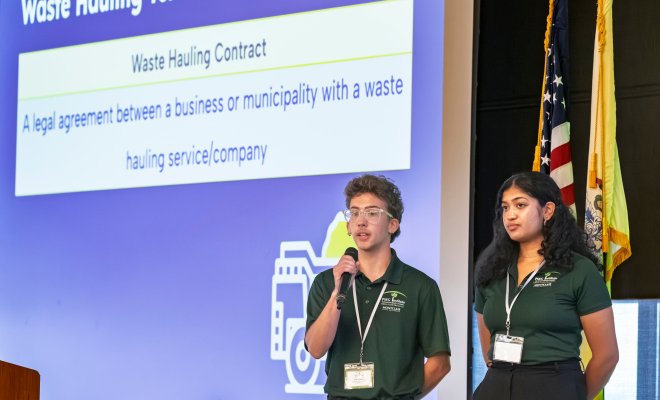
Each year, the PSEG ISS Green Teams conduct sustainability-focused projects and are tasked with producing specific deliverables designed in collaboration with the partner host organizations. The end of the program then culminates in a public event in which intern teams give TED Talk-style presentations on the projects they completed during the summer. This event brings together faculty, staff, partner organizations, friends, and family to celebrate the tremendous efforts made by the Green Teams interns to complete their assigned projects.
On this page, you can find Project Summaries for the 2023-2025 Green Teams Programs along with the Final Presentation recordings for the 2025 program year. The 2026 program year project summaries and final presentation recordings will be added following internal editing and review.
Green Teams Project Summaries
The drop-down sections below highlight projects from the 2023-2025 Green Teams cohorts. For a list of all project summaries between 2016-2025, please see the Master Project Summaries Document. The 2026 Green Team cohort Project Summaries will be added following our internal approval process.
2025 Green Teams
The 2025 Green Team continued the work of the 2024 Green Team by building on their virtual reality prototype.
To do this, the team:
- Updated the prototype to a mixed reality and upgraded the project to Unity 6. Also reduced the storage size of the project, optimized the number of scenes, and minimized lag.
- Created prefabs for all modules to ensure consistency and collaborated to integrate everything into a single Unity project using GitLab.
- Added three new modules: transplanting, harvesting, and packaging. Additionally, improvements were made to the 2024 VR prototype for filling flats and seeding.
- Added new accessibility features based on feedback from 2024, including a completion menu, an improved user interface, a progress bar, and instructional videos with auditory cues and subtitles, as well as pokeable buttons.
- Conducted user testing to evaluate the usability of the new modules and accessibility features.
In 2025, the Green Team serving Foodshed Alliance will build on the Arduino R4 system, known as "Soil Scout," developed by the 2024 Green Team. This initiative will analyze the impact of organic matter application and how the results vary across different conditions.
To do this, the team:
- Mapped the allotted space to fit 48 plots for biochar and compost application, and applied the amendment according to their conducted literature review
- Used an Arduino Uno R4 along with an Arduino R3 and transceiver with other electrical components, to connect to sensors for soil temperature and moisture, ambient temperature and humidity, and NPK sensor (nitrogen, phosphorus, potassium). And a 3D printed case to house the breadboard and sensors.
- Conducted a pot study replicating the field study, applied amendments at the same rate as the field, conducted laboratory testing on campus, and received soil results from Rutgers University
- Tested a Husky A200 rover at the Foodshed Alliance farm for sensor application to compare and contrast soil moisture with the pot study.
- Deployed NDVI drone imagery of the plots, and used ArcGIS Pro to analyze the crop stress, percent of vegetation vs percent soil to analyze the percentage of vegetation between plots.
The Green Teams worked with The Nature Conservancy to assist Paterson with tackling flood reduction, creating a climate risk data set and researching and promoting green infrastructure in the city. To do this the team:
The team serving The Nature Conservancy worked on the following deliverables:
- Analyzed the WSP Green Infrastructure (GI) Feasibility Study to highlight cost savings, maintenance needs and flood reduction potential, focusing on natural GI strategies and translating technical data into community metrics for public engagement
- Utilized GIS analysis to identify neighborhoods with high flood risk, heat exposure, and social vulnerabilities
- Created a decision matrix that outlined which wards in Paterson have the best balance of low cost and high impact for GI implementation
- Used data from the Office of Emergency Management to document local rain events and flooding patterns, creating a climate risk dataset that can inform planning and be integrated into the Paterson Greenprint tool.
- Developed a StoryMap and outreach materials (including various types of infographics and informational videos) to inform residents on flood challenges, the role of green infrastructure in building community resilience, and links to additional resources
- Tabled at a local community event to assess residents’ feelings regarding environmental conditions and the adoption/implementation of GI in their neighborhoods
The 2025 Green Team serving Greener Bloomfield/Township of Bloomfield completed the following deliverables:
- Educational Outreach: Created educational materials explaining the value of microforests for air quality, biodiversity, stormwater retention, and heat island mitigation.
- Community Engagement: Engaged community stakeholders to co-create a vision for the microforest site on a vacant lot.
- Impact Assessment: Conducted an environmental, social, and economic impact assessment for the half-acre site.
- Implementation Outline: Recommended project specifications including soil amendments, tree species selection, planting strategy, and location planning.
- Outcomes Forecast: Investigated and predicted the potential impacts of the microforest.
- Future Project Timeline: Developed a project roadmap outlining the development sequence, cost estimates, and 3–5 year maintenance needs.
The Hazel Avenue Green Team advanced food security, sustainability, and education through site planning, community engagement, and long-term program design. Their work included the following deliverables:
- Site Assessment & Planning: Tested soil, measured flood potential, and designed layouts for a greenhouse and community garden with options based on funding.
- Community Engagement: Ran surveys, gathered student and parent input, and hosted events such as a carnival table and soft launch to build buy-in and connection.
- Long-Term Plan: Created a phased engagement strategy with volunteer programs, local partnerships, and workshops to address food insecurity and sustain the garden.
- Curriculum Development: Designed STEAM-aligned lesson plans with hands-on learning (gardening, composting, nutrition) integrated into classrooms and the garden.
- Waste Reduction: Proposed composting programs, waste audits, and visual signage to reduce waste, increase recycling, and empower students as leaders.
The team serving City of Newark worked on the following deliverables:
- Attended multiple community events hosted by the Office of Sustainability and utilized the attendance rates and engagement feedback to develop an inclusive outreach strategy, conduct stakeholder mapping, and implement engagement tools (surveys, interviews, etc.) to gather diverse perspectives.
- Analyzed and synthesized feedback gathered from the June Unconference to identify community priorities, needs, and barriers to green space access
- Conducted a cost-benefit analysis of implementing greenspaces via traffic islands and determined the financial investment for the city, as well as the societal benefits for Newark residents
- Utilizing Google satellite maps, manually plotted traffic islands across Newark and developed GIS layers to identify areas of extreme heat, flooding, potential for pocket parks, and highlight areas that should be prioritized for green infrastructure implementation, complementary to Newark’s Sustainability Action Plan
- Researched native plants to assist in making green spaces most beneficial for the environment and efficient for combating air pollution, reducing emissions from industrial sites, and the ability to absorb flood water
- Produced a story map and other visual aids (graphs, charts, etc.) to communicate the city’s sustainability action plan, while providing constructive recommendations for the city to complete the project
The 2025 Green Team serving the Township of Montclair surveyed street trees in Montclair Township and collected data on tree conditions and locations. It assessed canopy equity, measured carbon uptake, and developed a strategic plan to expand tree coverage through the following deliverables:
- Street Tree Field Survey: Conducted fieldwork and created a street tree database documenting the location of the tree, pit length, pit width, diameter at breast height, scientific name, common name, and tree condition for a subset of streets in the Township of Montclair.
- Overburdened Community Tree Assessment: Quantified tree density and compared it to township-wide averages, and measured the carbon uptake of the trees using a carbon sensor to quantify vegetation and evaluate the environmental benefits of increasing the tree canopy in those areas.
- Equity Analysis: Developed an equity dashboard with summary reports on canopy disparities around the township.
- Implementation Plan: Developed a report and presentation outlining a strategic plan for enhancing the city’s tree canopy in the overburdened communities of Montclair.
The Green Team serving NJNG’s project is focused on building a business case on the most financially feasible option of CO2. The team has done this by completing the following deliverables:
- Developed CO2 Purification Business Case: Created a comprehensive analysis of the economic feasibility and market potential for CO2 purification and sale;
- Performed Sensitivity Analysis: Evaluated financial and technical risks for various CO2 purification systems under changing market and regulatory conditions;
- Compared Purification Technologies: Analyzed purification systems from different providers, focusing on costs, performance and certification compliance;
- Assessed Market and Regulations: Summarized market demand, certification needs, and regulatory requirements for CO2 purification in New Jersey;
- Integrated Renewable Byproducts: Identified opportunities to align renewable energy byproducts with CO2 purification using insights from the Ariana Yar study;
- Conducted Technical Feasibility Study: Used data and meeting notes to assess the implementation viability of CO2 purification systems.
The 2025 Green Team serving Port Authority of New York and New Jersey worked on the following deliverables:
- Water Assessment: Incorporated preliminary estimates of water usage, vulnerability, priority use types, and emergency response.
- Identified metering deficiencies and performed thorough water audits to evaluate current water usage.
- Loss Prevention Analysis: Detected leaks to minimize water loss and ensure efficient resource management.
- Opportunity Analysis: Identified opportunities to improve efficiency and water conservation across the system.
- Recommendations: Built on the Port Authority Emergency Drought Management Plan to enhance water efficiency and promote sustainable practices.
The 2025 Green Team serving Eisai’s project focused on understanding and developing an efficient way to report and understand their scope 3 emissions to ensure goals are met and reporting is done correctly. The team has done this by completing the following deliverables:
- Emissions Inventory: Developed a comprehensive database of all available Scope 3 emissions data by leveraging procurement and transportation information and clearly identified any data gaps.
- Policy Research: Conducted in-depth research on emerging Scope 3 reporting requirements, with a focus on California Senate Bills 219, 253, and 26.
- Competitor Analysis: Performed a competitor analysis on current Scope 3 reporting practices, identifying industry benchmarks and highlighting best-in-class approaches.
- Implementation Timeline: Prepared a detailed roadmap outlining Eisai’s required action items and implementation timeline.
2024 Green Teams
The 2024 Green Team serving dsm-firmenich continued the 2023 Green team serving dsm-firmeniches efforts to standardize green lab techniques and get a clear sense of the movement of lab materials.
To do this, the team:
- Began with the development of a project charter and a stakeholder map to define the project's scope and objectives, while identifying both internal and external stakeholders. From this, a comprehensive project charter was created.
- Compiled a master list of all laboratories, detailing information such as location, type, and specific functions, to help monitor metrics for improvements. Additionally, they reviewed the current green lab performance using a checklist of best and standard practices.
- Assessed Key Performance Indicators (KPIs) and company metrics to establish a framework for measuring crucial data such as water and energy consumption, identifying areas that require adjustments to align with our sustainability goals.
- Created a green labs tips page to be displayed in laboratories worldwide, featuring universal tips and tricks for enhancing lab sustainability in an easy-to-use format. Additionally they received certification from a non-profit organization “My Green Lab” and started the base work for a chemical exchange program.
The 2024 Green Team serving NJR researched best practices in environmental stewardship, carbon assessment and modeling, developed communications and ecosystem services.
To do this the team:
- Conducted an assessment of carbon sequestration reporting frameworks for coastal ecosystems. With this assessment, the team then developed measures or estimates in various coastal areas using a LICOR to collect carbon sequestration data.
- Built a potential model, including key performance indicators (KPI), to evaluate stewardship project impacts. The model was built into a fully functional calculator that would return a score ranked from 0-1 based on KPIs entered.
- Evaluated and communicated ecosystem services as benefits to residents by including community affected variables, especially in EJ communities. This section was a part of the Socioeconomic KPI section of the calculator with detailed descriptions of each category.
The 2024 Green Team serving the Township of Washington assisted the township with their flooding issue with mapping and educational content
To do this, the team:
- Conducted a preliminary hydrological assessment by doing a complete field survey focused on flood-prone areas in Washington Township. After they created surveys/focus groups with residents to learn more about local, small-scale flooding on private land.
- Mapped the land use in Washington including sources of water in the area such as rivers, streams and more. With this data they found points of potentially compounded runoff from storm drains that contribute extra water from outside the watershed. They also created a map on impervious surfaces in Washington Township and ran analysis to see the runoff calculations and risk analysis.
- Outlined flood mitigation strategies as the first steps for the development of a flood mitigation plan using the data from their survey and recommended green mitigation such as buffer zones, adopt a drain and love your lawn initiatives.
- Begun community outreach through surveys, infographics, educational materials and a cultivated story map of their research and findings.
The Green team serving HMH and KPM provided the company with research on the benefits of adding EVs in their fleet and the future projections of the benefits of having EVs.
To do this, the team:
- Summarized current infrastructure and use of EVs in the US (versus Europe) and Identified policy limitations and incentive opportunities for EV adoption.
- Assessed - if the grid can handle electrifying vehicle fleets as well as emissions savingsthrough widespread EV adoption in healthcare.
- Provided market analysis for attitudes and perceptions regarding EVs within healthcare and external industries. Also conducted a Historical analysis to Identify other industries that have introduced transformative technologies and the time frame of adoption.
- Estimated ROI for EV infrastructure needed to support EV adoption in healthcare and proposed the next steps to incentivize and motivate market transformation in this sector.
The Green Team serving the Port Authority of New York and New Jersey researched their Auxiliary Power Units (APU) from various planes to improve emissions.
To do this, the team:
- Developed Auxiliary Power Unit (APU) reduction strategies by collecting field data on APU usage at airport gates (Newark, JFK, and/or LaGuardia airports). They did this through research, airport site visits and alternative company insights.
- Collected real life data from planes on the tarmac and compared the data to an online platform named Flight aware, that gives real time flight tracking data.
- Proposed methods for estimating that should be used in future PANYNJ GHG inventories.
- Conducted research on strategies for reducing APU high emission energy usage and provided data on what real low vs high usage would look like and the importance of the usage APU alternatives.
- Proposed policies and initiatives that could be used at PANYNJ airports for reducing APU usage through incentives and the creation of new policies with a key to show what recommendations are more or less favorable.
The 2024 Green Team Serving FoodShed Alliance traveled to Kansas State university to understand the impacts of agriculture on the food system, did on-site analysis, and built 3D modeled prototypes for flood indication.
To do this, the team:
- Focused on understanding site conditions at Sage Farm to enhance precision agriculture practices.
- Conducted power analysis and soil testing to assess crop nutrition needs and optimize irrigation systems, with field sampling and soil moisture heterogeneity analysis the team identified dry spots and potential irrigation zones.
- Used Arduino Uno R4 along with other sensors for temperature, soil moisture, and humidity and a 3D Printed case to be placed on site.
- Designed and tested a robotic variable rate application sensor to identify areas with insufficient moisture, and a trial drip irrigation system was implemented to optimize water use and support crop health.
- Deployed Drone technology for aerial imagery of two sites owned by FSA that was later transferred into ArcGIS to be further analyzed using spatial analysis.
The 2024 Green Team serving The City of Paterson Created maps detailing food desert prone areas, created a food policy audit, and hit the ground to gain real community input with outreach materials.
To do this, the team:
- Conducted in-depth research on successful food programs, such as food policy councils, farmer's markets, and urban gardens, in cities with demographics similar to Paterson.
- Developed a comprehensive map identifying food deserts and various food sources within Paterson, including supermarkets, farmers' markets, community gardens, bodegas, and food pantries. The map highlights areas in need of increased accessibility to healthy food.
- Performed a detailed audit of existing food policies, identifying opportunities for policy changes in ordinances, zoning, permitting, and procedures to enhance food accessibility, food justice, and resilience.
- Engaged local food stakeholders and city officials through focus groups to assess their current actions, challenges, and capacity to contribute to developing a healthy food system.
- Created outreach materials to promote existing farmers' markets and community gardens in Paterson. These materials were produced in English and other relevant languages to ensure broad accessibility.
The 2024 Green Team serving The Township of Verona provided an informed opinion to the township of Verona council on the health and economic effects of using turf.
To do this, the team:
- Conducted a study to evaluate the environmental and economic impacts of artificial turf versus natural grass.
- Reviewed current research, performing a cost-benefit analysis, assessing playability and long-term effects, and conducting an environmental assessment.
- Spoke in front of the Town Council about their findings and informed opinions.
- Informed a proposal for updating Centennial Field, a 13-year-old turf field nearing the end of its life, to determine whether it should remain artificial turf or be converted back to natural grass.
The 2024 Green Team serving Greens do Good also visited Kansas State University
To do this, the team:
- Researched human computer interaction and created a use case diagram for the program.
- Created a training module on VR to help train students with autism. They initially decided on three different versions, two types of augmented reality programs, and one virtual reality program. The simulations were to follow along with two provided training models, based on capability level of the students.
- Decided on and created two types of programs one Augmented reality and one fully virtual. The two modules were to first, place the Ihort plugs in the Ihort tray and then the second module was to place seeds in the holes of the plugs.
- Tested the programs on the students with Autism and the program and are now in their refinement period.
The 2024 Green Team serving the Northern New Jersey Community Foundation did the following:
- Assisted the Northern New Jersey Community Foundation with their new Green infrastructure plan as well as the flooding issue in Hackensack, NJ by doing some preliminary research on Green Infrastructure to get a clear understanding of how well it does in urban areas.
- Converted their research into educational content where they separated each type of green infrastructure to various infographics that were translated in both spanish and english.
- Provided maps on Hackensack showing the demographics, elevation, tree canopy, and old redlining classifications to assess the environmental justice issues there. They took these maps and implemented them onto a Story Map that tells the entire story of what they did and what they found.
- Participated in a community event where they offered their infographics along with a map to mark where GI should go, two boards to get the public's opinion on their current environmental issues, and a survey they created to hear more feedback from the community. All of their work was part of a greater project that NNJCF has collaborated with various other change makers in Hackensack and the Beren Area.
2023 Green Teams
The Green Team serving dsm-firmenich worked on the following deliverables:
Theme: Sustainable Laboratory Practices
- Creation of a Green Lab Challenge
- Eight month program with each month introducing a new “theme” within sustainability (i.e. solid waste reduction, energy reduction, etc.).
- Lab members focus on one initiative for the month
- Green Lab Certification Program
- Expansion on GLC, each lab is given a score card and can keep track of points2 they earn for making sustainable choices
- The amount of points a lab earns gives them a ‘score’ earning Platinum, Gold, Silver, or Bronze status
- Promotes competitiveness among labs
- Improve Social Sustainability
- Improve sustainability culture among employees
- Creation of social events in the GLC (i.e. Lunch and learns)
- Employee satisfaction survey
- Green Chemistry Book (Add-on)
- Reduce lab waste and improve overall lab sustainability
- Recommends alternative chemical reactions, solvents, etc.
The Green Team serving HMH worked on the following deliverables:
Theme: Sustainable Transportation (EVs)
- Analyze transportation tracking software and data collected at HMH
- Estimated annual emissions and transportation costs
- Analyze transportation emissions
- Determined a majority of emissions came from employee commute
- Recommend sustainable transportation strategies
- Creation of a sustainable transportation program
- Designed a Carpool program
- Incentivized public transportation
- Creation of Electrification Guide (Home Health Care Fleet)
- Cost-Benefit Analysis of fuel efficient tires
- Strategized solutions to vehicle idling and subsequent emissions
- Creation of a sustainable transportation program
The Green Team serving MSK worked on the following deliverables:
Theme: Sustainable Building Design in Healthcare
- Researching and recommending healthy building design strategies
- Focus: Assist MSK’s new cancer care pavilion, to be built on Manhattan’s upper east side by 2030, in achieving a LEED platinum certification
- Outcome: Detailed report and shortened summaries including information they sourced from industry experts, building design guidelines, and USGBC Anthology
- Assessing occupant and community benefit of those healthy building designs
- Focus: staff and patient benefits
- Highlighted metrics and KPIs to assess effectiveness of building designs
- Presented an Entity-Relationship model for a SQL database that could help track environmental metrics for furniture and furnishings purchased by MSK.
The Green Team Serving MSU Facilities worked on the following deliverables:
Theme: Sustainability in Dorms and College Campuses
- Irrigation
- Data collected via robotic sensors; soil moisture, humidity, temperature and air quality
- Water meter to measure water usage from the hoses on campus
- PVC used to collect data for water infiltration test
- Restroom Sensors
- Toured CCIS and determined best option is to replace battery operated sensors and recommended wired sensors
- Recycling
- Determine the types of recycling bins used on campus
- Researched best recycling bin signage practices
- Created “Bin Generalization Sheet”
- Most efficient being type “G” that has a waste and recycling compartment in one bin
- Dorm-Move Out
- Researched strategies to reduce move-out waste
- Recommendation- University can collect items from students during move-out to donate
- Creation of Student survey to assess opinions on move-out waste strategies
- “Fill it Forward” Campaign
- Creation of short film and posters with QR code
- Fill your bottle and scan QR code, small donation is made to charity, eligible to win prizes
- Tested the Fill it Forward app
- Creation of short film and posters with QR code
The Green Team serving NCFS worked on the following deliverables:
Theme: Food Security and Community Involvement
- Creation of an Urban Agricultural Social Media Campaign
- Infographics and infomercials
- “Lettuce Eat Too” Event
- Local Growers meet up- continuation of the 2021 event
- A catered event, with cooking and hydroponics workshops
- Focused on community engagement and conversation
- Local Growers meet up- continuation of the 2021 event
- Data Collection
- Designed a database that growers can use to collect data and generate statistics
- Focused on data visualization strategies that will assist growers for the purposes of grant writing, education, and data updates.
- Creation of interactive maps
- Food Apartheid Map
- Citywide Garden Tour Map
- Maps use data to tell a story about food insecurity and garden relationships in Newark
- Supplementary tool for streamlining the Citywide Garden Tour
The Green Team serving New Jersey Resources worked on the following deliverables:
Theme: Food Waste in NJ
- NJ Organic Waste Landscape
- 6 million tons of municipal solid waste (2020) and ⅓ is digestible
- U.S. has a goal to reduce food waste in half by 2030
- NJ Food Waste Policy
- Food Waste Recycling and Food Waste to Energy Production Law
- Any large food waste generator that produces 52 tons annually has to send their waste to an authorized food waste recycling facility that is within 25 road miles
- Food Wholesale realtors generate most waste- 1.2 million tons
- Food Waste Recycling and Food Waste to Energy Production Law
- Policy Amendments
- Expand mileage
- Decrease threshold
- Mandate Recordkeeping
- Separate waste collection streams
- Waste to energy
- Anaerobic digestion
- Renewable natural gas
- Avoid landfills when possible
- Closed-Loop systems
- Costs and Emission Reductions
- 20% GHG reduction from RNG
- 60% GHG reduction from Cellulosic fuels
- NJ R’s Transition
- Form relationships and contracts with food waste generators to ensure consistent flow (I.e. ACUA)
- Addition of a new facility to serve more of the population
The team serving New Jersey Transit worked on the following deliverables:
Theme: Reducing NJ Transit’s Ecological Footprint
- Assess current waste data systems
- Team visited four sites to hand out surveys and questionnaires
- SWOT, gap, and policy analyses
- Create uniform signage across sites
- Posters indicate what's recyclable
- Educational stickers to workers
- Creation of other interactive materials
- Communicate findings to employees
- Creation of final report
The Green Team serving PANYNJ worked on the following deliverables:
Theme:
- Mapping hydrants and valves for emergency shut off
- Tools: ArcGIS Pro, Field maps, and Eos Arrow 100 GNSS
- Collected over 50 points including hydrants, valves, and water main valves.
- Creation of energy consumption calculator
- Excel data of energy consumption logs from the port's buildings were manipulated into three models
- Linear regression, polynomial regression, sinusoidal model (recommended)
- With more data that's more consistent, above models will assist in creation of energy consumption calculator
- Further recommendations:
- Use of Arc indoor monitor for indoors, working on a baseline consumptions analysis, and trying out a multi-regression model
- Excel data of energy consumption logs from the port's buildings were manipulated into three models
The team serving PSEG worked on the following deliverables:
Theme: Improving Sustainability within PSEG
- Competitor Analysis
- Looked at PSEG’s Utility and non-utility peers
- Developed KPIs that measured:
- Employee demographics
- Charitable contributions
- Sustainability Performance
- SWOT Analysis
- Based off of results found in the competitor’s analysis
- Task force on Nature related disclosures (TNFD) Report
- Provided a summary and recommendations to PSEG
The Green Team serving Stryker worked on the following deliverables:
Theme: Sustainability within Stryker (Medical Technology)
Stryker’s goals: 100% renewable electricity by 2027 and being carbon neutral by 2030
- Build a comprehensive database containing financial incentives and rebates for sustainability related initiatives
- Emphasis on renewable energy and energy efficiency
- Collected incentives from local utilities, counties, states, the federal government, sustainable R&D credits, and Inflation Reduction Act (IRA) provisions to create excel based database
- Investigate renewable energy
- Created a framework for future calculations to determine an optimal mix to get Stryker to their 100% renewable energy goal
- Investigate and analyze sustainability incentives and resources
- Created a sustainable development framework that aligns with the SDGs of the United Nations
Final Presentation Videos
Recordings of the 2025 Green Teams final presentations