Academic Department

Department of Earth and Environmental Studies

  • College of Science and Mathematics

The Department of Earth and Environmental Studies has the dual benefits of a small department where our students and faculty members know each other by name, but one that is large in stature through our world-class faculty who provide hands-on learning experience in projects supported by NASA, the U.S. Environmental Protection Agency, the National Science Foundation, and carried out in study areas including the Alaska Arctic Tundra, Antarctica, and every place in between.

973-655-4448
Center for Environmental and Life Sciences Room 220
Areas of Study

The Department of Earth and Environmental studies offers a suite of BS, MS, and  graduate certificate programs in Earth and Environmental Science, GIS and Remote Sensing, Water Resource Management, and Environmental Forensics. We also house the university-wide transdisciplinary PhD Program in Environmental Science and Management. Our programs prepare future scientists who are equipped to address complex issues including the mechanisms and effects of climate change, identifying the nature and source of contaminants in the environment, designing novel methods of removing contaminants from air, water, and soil, understanding interactions between humans and the coastal zone, developing strategies for responsible land use and water resource management, and understanding the workings of our planet from the core to the top of the atmosphere.

Earth and Environmental Scientists are employed by:

  • State and federal agencies that oversee environmental protection, land use management, energy, water quality, and water resource conservation and management
  • Environmental consulting and engineering firms that remediate and redevelop contaminated sites
  • Mining and petroleum exploration companies that locate and extract mineral and petroleum resources
  • Law firms that specialize in environmental law
  • Public and private school districts
  • Colleges and universities
  • Museums, nature conservancies, and publishers and producers of science books, magazines, websites, and broadcasts

Students interested in these career paths are best served by earning a degree in Earth and Environmental Science. Each Montclair State University degree program includes carefully selected core courses and provides flexibility to select electives in disciplines such as Earth Surface Processes and Hydrology, Environmental Quality and Remediation, Geology & Geophysics, or GIS and Remote Sensing. Students looking to augment their existing credentials are also encouraged to explore our post-graduate certificate programs in Environmental Forensics, Geographic Information Science and Remote Sensing, and Water Resource Management.

Job Outlook and Salary Information for Earth and Environmental Scientists

Professional Geologist Licensure

New Jersey currently does not have licensure requirements for geologists. However, New York and Pennsylvania (along with Alabama, Delaware, Kansas, Louisiana, New Hampshire, Minnesota, South Carolina, and Texas) require licensure for companies carrying out geological work in their states. EAES alumni working for New Jersey environmental consulting and geoengineering firms are seeking licensure through NY and PA. Anecdotally, these alumni recommend that new graduates will be more competitive job applicants by beginning the Professional Geologist licensure process early, starting with the Fundamentals of Geology (FG) exam (step 1 of the multi-part process).

Below are online resources that explain the Professional Geologist licensure process nationally and regionally and requirements for New Jersey’s “Site Remediation Licensure” process.

National Resources for Professional Geologist Licensure

New Jersey State Licensure

New York State Licensure

Pennsylvania State Licensure

Professional Resources for Earth and Environmental Scientists

The Department of Earth and Environmental Studies offers a BA in Geography, and minors in Geographic Information Science and Urban Studies.  We also house MS programs in Sustainability Science and Earth and Environmental Science, and the university-wide transdisciplinary PhD Program in Environmental Science and Management. Our programs emphasize human interactions with the physical environment, environmental law and policy, environmental economics, environmental management, and urban environments. The degree includes requirements and electives with allied disciplines in the sciences, social sciences, and humanities, allowing easy combination with a number of minors. Students in Geography gain practical skills using Geographic Information Systems and Remote Sensing, experience with both field and laboratory methods, and participate in research and internship opportunities.

Geographers are employed by:

  • State and federal agencies that oversee natural resource management, conservation and environmental policy
  • Municipal agencies that oversee city planning, transportation planning, open space conservation, public health, and environmental health
  • Non-profit organizations dedicated to protecting the environment and educating the public about climate change, clean water, energy conservation, food security, and biodiversity and habitat preservation
  • Industries that utilize geospatial datasets for environmental planning, design and construction, research, and marketing
  • Law firms that specialize in environmental law
  • Public and private school districts
  • Colleges and universities

Students interested in these career paths are best served by earning a degree in Geography. Montclair State University’s Geography programs integrate environmental and social science and lay the foundation for understanding a variety of modern global and regional issues.

Job Outlook and Salary Information for Geographers

Professional Resources for Geographers

The Department of Earth and Environmental Studies offers a suite of Sustainability Science programs including a BS and MS in Sustainability Science, a combined 5 year BS/MS in Sustainability Science, a Professional Science Masters in Sustainability Science, and graduate certificates in Geographic Information Science and Remote Sensing, Water Resource Management, and Environmental Forensics. The Department of Earth and Environmental Studies also houses the university-wide transdisciplinary Ph.D. Program in Environmental Science and Management.

Montclair State University Sustainability programs lead the way in New Jersey in integrating natural and physical science with social science, economics, policy, and project management to prepare sustainability professionals and managers to tackle society’s most complex and pressing environmental problems. Our Sustainability Science programs are housed in the Department of Earth and Environmental Studies, and take advantage of expertise across campus including the College of Science and Mathematics, College of Humanities and Social Science, School of Business, and the PSEG Institute for Sustainability Studies.

Our programs are designed to provide a comprehensive understanding of:

  • Earth’s natural systems that support and nurture life.
  • Human interactions with and influences on Earth’s systems
  • The intersection of science, economics, law and policy
  • Organizational approaches to sustainability issues in communities, businesses, government agencies, and non-governmental organizations (NGOs)
  • Project development and implementation, data collection, analysis, and interpretation, via either a thesis or applied internship project.

Sustainability professionals and managers are employed as:

  • Alternative energy specialists
  • Business operations specialists
  • Chief Sustainability Officers
  • Civil engineers
  • Compliance officers
  • Conservation scientists
  • Energy and water usage auditors and managers
  • Environmental lawyers
  • Financial analysts
  • Green design and construction specialists
  • Industrial ecologists
  • Industrial managers
  • Life cycle assessment specialists
  • Marketing specialists
  • Project managers
  • Recycling coordinators
  • Transportation, storage, and distribution managers
  • Urban and regional planner

Students interested in these career paths are best served by earning a degree in Sustainability Science degree. The Montclair State University Sustainability Science programs are the right curriculum, the right location, and the right choice for you.

Job Outlook and Salary Information for Sustainability Scientists

Professional Resources for Sustainability Scientists

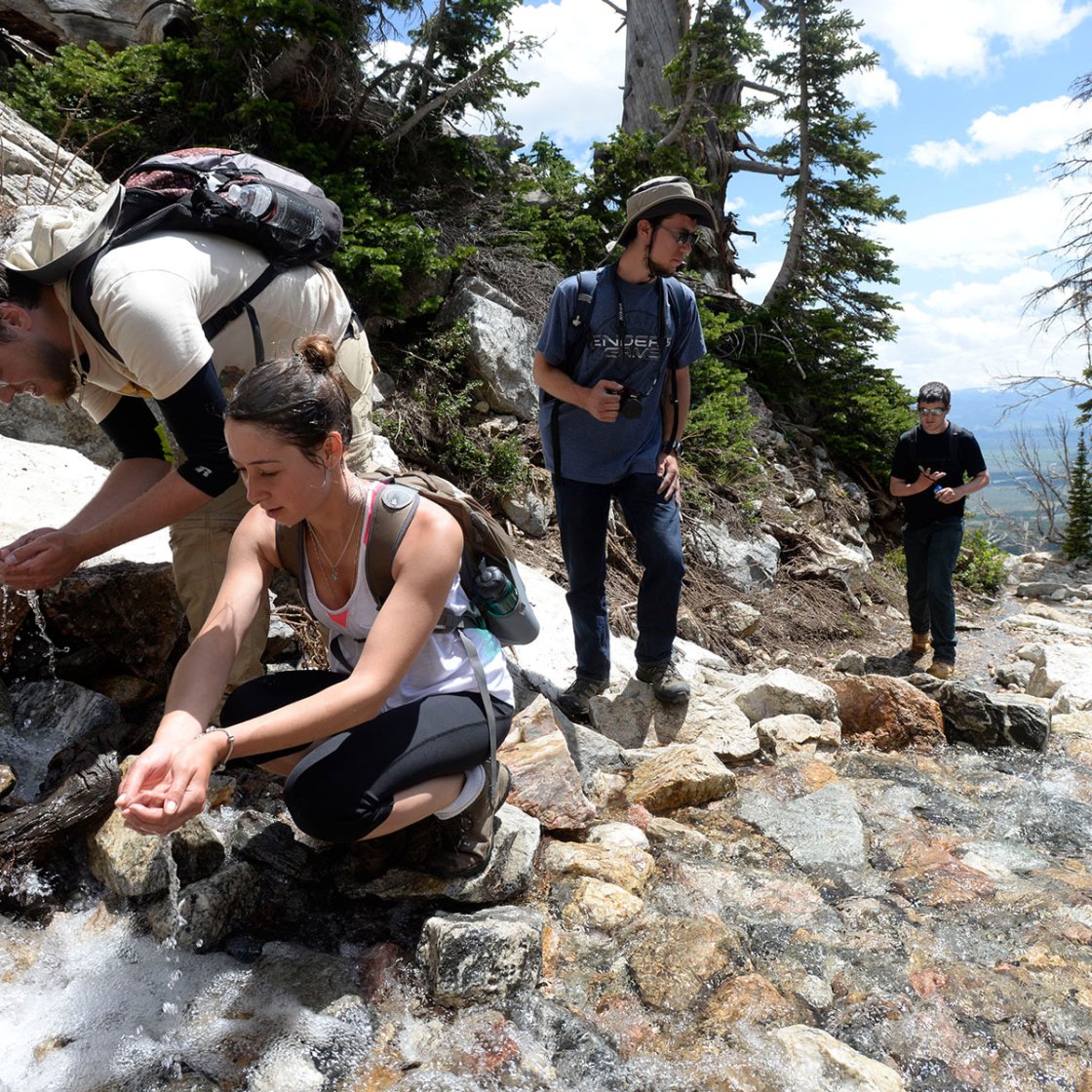
students on a field geology trip getting water from a stream flowing down the mountain

EAES Research and Facilities

The Department of Earth and Environmental Studies (EAES) has a group of dedicated faculty that work in areas that are truly global, and span the local New Jersey/New York metropolitan area to coastal New Jersey, upstate New York, Massachusetts, the southwestern United States, Argentina, Brazil, China, India, the Netherlands, Ghana, Nigeria, the Philippines, the Arctic, and Antarctica. We take great pride in including our graduate and undergraduate students in our field programs and teaching them to collect and analyze their own data using state of the art instrumentation and data processing software. Our research is aided by external grants plus small internal seed grants from the University that support a diverse array of research topics, broadly grouped in the following foci: Geodynamics and Earth materials, Global environmental change, Urban environments, environmental policy and education, and Water pollution and water resource management.

When conducting research in lab spaces it is important to know the safety protocols.

Research Disciplines/Topics

  • Earth’s glacial record and long-term global change, marine geology and geophysics, paleoclimatology, ice sheet-ocean interactions in the Antarctic and Arctic regions, mineral magnetism, paleomagnetism, terrestrial and planetary magnetism
    Sandra PasschierStefanie Brachfeld, Ying Cui
  • Environmental Management, Urban Studies
    Robert Taylor
  • Geochemistry and Petrology of Mafic Volcanics, Mantle Xenoliths and igneous and metamorphic rocks of the Hudson Highlands and Newark Basin, Geology and Tectonics of the Southern Andes, Analytical Geochemistry
    Matt Gorring
  • Geochemistry, contaminated sediments, riverine, estuarine and marine environmental geochemistry
    Michael Kruge (Emeriti), Huan FengYing Cui
  • Geography, GIS/Spatial statistics, urban & regional studies
    Danlin Yu
  • Geomorphology, hydrology, soils
    Greg PopeJosh Galster
  • GIS/Remote Sensing
    Mark ChoppingDanlin Yu and Josh Galster.
  • Hydrogeology, Groundwater Modeling
    Duke Ophori
  • Stable isotope geochemistry
    Ying Cui
  • Sustainability, Energy, Environmental Economics, Environmental Policy
    Pankaj Lal